Roof Valley Leaking? 6 Causes, Found From the Loft
By the Professional Roofers team
Updated 2026 · Independent cost guide
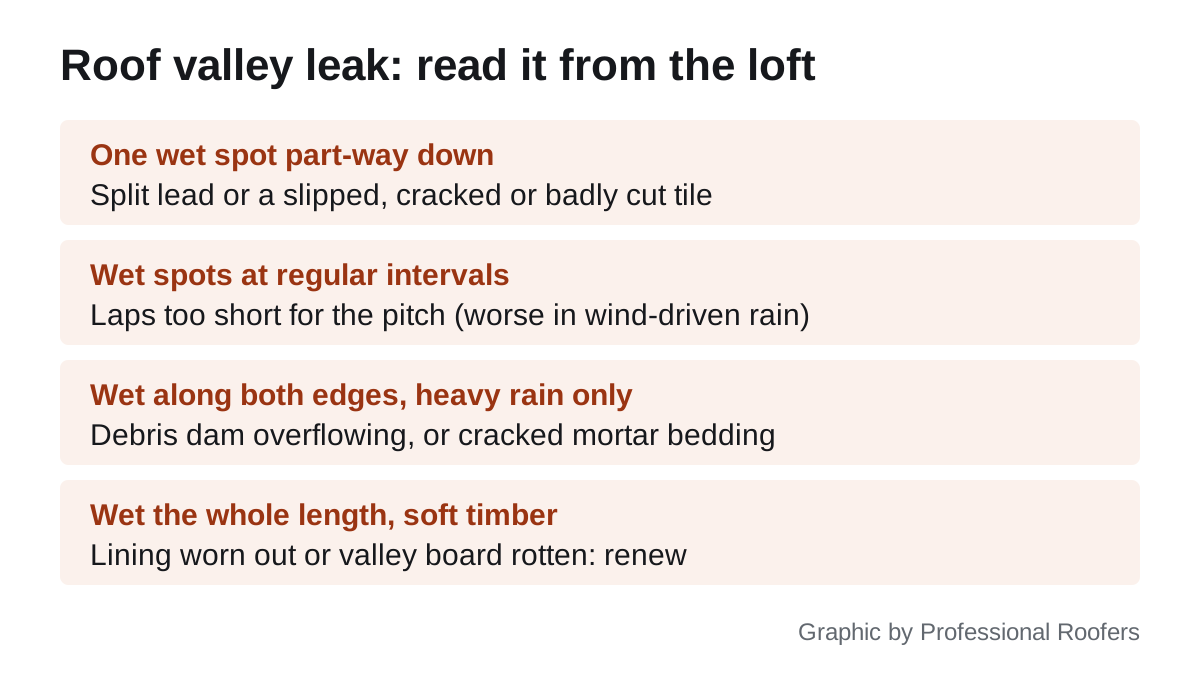
A roof valley leaking is one of the most common roof leaks in Britain, because the valley carries the rain off two slopes through one channel. The good news is that valleys fail in a small number of ways, and you can usually tell which one you have before a roofer climbs up: what the valley is made of, where the water appears in the loft, and whether it leaks in every shower or only in driving rain or a downpour.
This page is the diagnosis. If you want to know how each valley type is built and specified, our guide to roof valley types compared has the detail, including the lead and GRP lap tables.
First, find out what your valley is made of
From the ground, with binoculars if you need them:
- Open lead valley: a strip of grey metal visible down the valley, with tiles or slates cut back on both sides.
- GRP valley: a moulded trough, usually dark grey or black, often with ribs or a raised centre, with tiles cut to it on each side. Common on houses built or re-roofed since the 1990s.
- Mortar-bedded valley: tiles cut to the valley line and bedded in a run of mortar along each side, over a lead or GRP lining you cannot see well.
- Valley tiles or a laced/swept valley: on plain tile and slate roofs, purpose-made curved valley tiles or slates worked round the valley with no visible gutter.
The six causes, and how each shows itself
1. Debris dam
Signs: leaks in heavy rain but not light rain; moss, leaves or tile granules visible in the valley; a tree nearby. Water overflows the sides of the channel and runs under the tiles.
This is the most common cause and the cheapest to fix. A GRP trough has a narrower channel than a generous open lead valley, so it dams sooner. Clearing it (and the gutter at the bottom, which is often the real blockage) may be the whole job. If moss is the source, see our roof moss removal page; scraping a valley without fixing the roof above just refills it.
2. Split lead
Signs: an open lead valley; drips in the loft in a line part-way down the valley rather than at the bottom; a crack visible across the lead, often ragged.
Lead splits from thermal movement when it has been laid in pieces longer than the 1.5m the lead industry’s guidance allows, or nailed down the sides instead of only across the top. A sealant or patch buys time, but the cause is in the length and fixing of the piece, so the lasting repair is to relay that section in shorter pieces. Our leadwork guide explains codes and fixing.
3. Lap too short for the pitch
Signs: leaks only in wind-driven rain; water appears at regular intervals down the valley, where one piece of lead or GRP overlaps the next; often a shallow roof.
On a shallow pitch water backs up further before it drains, so the overlap between lengths has to be longer. Lead needs 150mm laps at 30 degrees and above, rising to 220mm at 20 degrees. Marley’s GRP valley needs 400mm at 15 to 17 degrees but only 150mm at 40 degrees and above. A fitter who used a steep-roof lap on a shallow valley has built a leak, and the fix is to relap or replace, not to seal.
4. Cracked mortar bedding
Signs: mortar-bedded valley; gaps, cracks or missing mortar along the tile edges; small pieces of mortar in the gutter below.
Mortar shrinks, cracks with frost and movement, and lets water run underneath the cut tiles and off the edge of the lining. Repointing is a short-term fix. The better repair is to rebed or replace with a dry-fixed system. For context on why the industry moved away from mortar, see our dry ridge vs mortar ridge page and BS 5534 explained.
5. Badly cut or slipped tiles
Signs: a tile or slate along the valley sitting out of line, or with a gap; leaks close to that point.
The tiles each side of a valley are cut to a consistent margin so water lands in the channel, not on the edge. A slipped, cracked or badly cut tile can direct water past the lining. This is usually a small repair, similar to a slipped tile repair.
6. Worn-out lining or rotten valley board
Signs: an old roof, often pre-war; lead thin, cracked in several places or patched repeatedly; soft or dark timber under the valley in the loft; daylight visible.
At this point it is not a repair. The valley needs stripping back, new boards if the timber is soft, and a new lining, often with new underlay either side. If the rest of the roof is near the end of its life too, compare this with a re-roof: see new roof cost.
Read the loft before anyone climbs a ladder
Go up during or just after rain with a torch:
- Find the valley from inside. It is the line where the two roof slopes meet; you will see the valley board or the underside of the lining.
- Look for the highest wet point. Water runs downhill along the board and rafters before it drips, so the ceiling stain can be well below and to one side of the actual entry point. The top of the wet trail is close to the leak.
- Note the pattern. One wet spot part-way down suggests a split or a slipped tile. Wet spots at regular intervals suggest laps. Wet along both edges suggests overflow (debris) or failed mortar. Wet along the whole length, with soft timber, suggests the lining is finished.
- Check the bottom. If the wet starts where the valley meets the gutter, the gutter may be blocked or too small for the volume a valley sends into it. Our box gutter leaking and gutter leaking at a joint pages cover those.
Take photos. They save a roofer time and help you compare quotes. If you cannot see the source, our general guide to how to find a roof leak helps rule out chimneys, flashings and condensation, which can all look like a valley leak.
Repair, patch or renew?
- Clear and check: for debris dams, clear the valley and gutter, then watch it in the next heavy rain.
- Patch or seal: acceptable as a stopgap for a single split in lead or GRP, or a small mortar crack. Not a fix for short laps or a lining at the end of its life.
- Relay a section: for a split lead piece that was too long, or a single bad lap.
- Renew the valley: for repeated splits, rotten boards, or an under-lapped valley along its length. Ask whether it will be lead (to the 1.5m piece and lap rules) or GRP (to the maker’s lap table for your pitch), and get that written into the quote. Our questions to ask a roofer list covers the rest.
If water is coming through a ceiling now, put a tarpaulin or bucket under it in the loft, turn off lights on that circuit if the water is near fittings, and see our emergency roof repair page. Storm damage to a valley may be covered by your policy; wear and tear usually is not (home insurance and roofs).
Frequently asked questions
Why is my roof valley leaking only in heavy rain? Usually because the valley overflows. A build-up of leaves, moss or granules narrows the channel, or the gutter at the bottom cannot take the volume, so water spills over the sides and under the tiles. Short laps on a shallow roof cause the same symptom in wind-driven rain.
Can a leaking roof valley be repaired, or does it need replacing? Many can be repaired: clearing debris, refixing a slipped tile, rebedding cracked mortar or relaying one split piece of lead. A valley that has split repeatedly, is under-lapped along its length or sits on rotten boards needs renewing.
Is a GRP valley better than lead? GRP is cheaper, lighter, has no scrap value to thieves and has no mortar to crack if dry-fixed. Lead laid to specification lasts longer and has a wider channel. Both leak if laid with laps too short for the pitch.
How do I know if the leak is the valley or something else? Trace it from the loft. If the highest wet point is on the valley board or along the valley line, it is the valley. Wet around a chimney, a roof window or a dormer points to flashing instead.
Can I seal a leaking lead valley with sealant? As a temporary measure only. A split in lead usually comes from thermal movement in a piece that is too long or over-nailed, and sealant does not stop that movement, so the split reopens.
Sources
- Lead industry lead flashing guide hosted by slateroofers.org (piece lengths, laps, fixing).
- Marley, universal GRP dry valley technical page (lengths and lap table by pitch).
Want costs like this each month?
Join the Roofline brief for current UK prices and quote-reading tips.
More from Professional Roofers

How Much Does a New Roof Cost in the UK in 2026?
What a new roof really costs in the UK in 2026, broken down by house size, material and the hidden extras, plus how to check you are being quoted fairly.
Chimney Repointing and Repair Cost UK (2026)
What chimney repointing cost is in the UK in 2026, why scaffolding drives the price, and how repointing compares to rebuilding, flashing and pot repairs.
Roof Inspection and Survey Cost UK: What's Checked and the Price
Roof inspection cost UK 2026: what a ground, ladder or drone survey checks, typical prices for each, and when a written roof report is worth paying for.