Roof Valley Types Compared: Lead, GRP, Dry and Mitred
By the Professional Roofers team
Updated 2026 · Independent cost guide
A valley is where two roof slopes meet and every drop of water off both of them has to leave through one channel. It is the hardest-working detail on a pitched roof and the first place most roofs leak, so the roof valley types on offer are worth understanding before a quote lands on your kitchen table with one line saying “renew valley”.
There are four in common use in Britain: open lead, GRP dry valley trough, a proprietary dry valley system, and the mitred or swept valley cut in slate. They do not cost the same, they do not last the same, and they fail in completely different ways.
Open lead valley
The traditional one. Sheet lead is laid in a timber-lined channel between the two slopes, and the tiles or slates are cut back on each side so the lead shows as an open gutter.
The figures that matter come from the lead industry’s own flashing guidance, and they are more specific than most homeowners realise:
- Code 4 or Code 5 lead for a pitched valley gutter. Code refers to the thickness; higher is heavier.
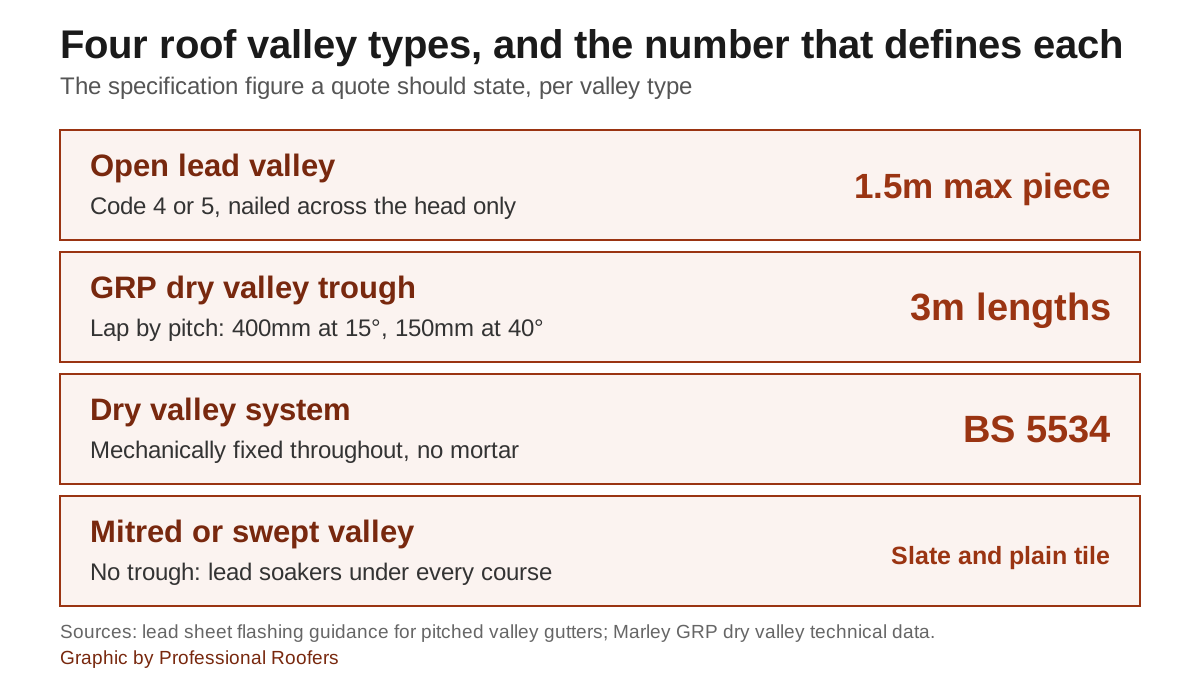
- Pieces no longer than 1,500mm. This is the single most important number on this page.
- Laps of 150mm between pieces on pitches of 30 degrees and above, increasing to 220mm at a 20-degree pitch.
- Fixed across the top only, with two rows of copper or stainless steel clout nails. Not galvanised steel, not aluminium.
- Valley boards level with the tops of the rafters, so the tiling battens and tilting fillets sit at the same height.
Done to that specification, a lead valley will outlast the tiles above it. Nobody is arguing against lead on performance.
How it fails, and why it is always at the laps. Lead expands and contracts a great deal with temperature. That is the whole reason for the 1.5m piece limit and for nailing only at the head: each piece has to be free to move. Two mistakes undo it. Running one long sheet down a whole valley instead of overlapping short pieces means the accumulated movement has nowhere to go, and the lead fatigues and splits, usually in a ragged line across the sheet. Nailing down the sides has the same effect in miniature, and the industry guidance says so directly: restricting free thermal movement results in failure.
The second failure mode is a lap that is too short for the pitch. On a shallow roof, water backs up further before it drains, and a 150mm lap that is fine at 40 degrees will let water track back uphill at 20. If you have a shallow valley that weeps in driving rain, check the lap before you condemn the lead.
Lead is also the expensive option, and the one that attracts thieves. See our leadwork and lead flashing guide for the wider picture, and roof flashing repair costs for what remedial work involves.
GRP dry valley trough
Glass reinforced plastic moulded into a valley-shaped trough, nailed into the valley and dry-fixed with no mortar. It is now the default on new build and on most re-roofs where lead is not specified.
Manufacturer data is precise here. Marley’s universal GRP dry valley comes in 3,000mm lengths, cut to size on site, and sets its laps by pitch:
| Rafter pitch | Minimum lap |
|---|---|
| 15 to 17 degrees | 400mm |
| 17.5 to 22.5 degrees | 350mm |
| 22.5 to 29 degrees | 300mm |
| 30 to 34 degrees | 250mm |
| 35 to 39 degrees | 200mm |
| 40 degrees and above | 150mm |
Those are worth seeing written out, because they say something the marketing does not: on a shallow roof a GRP valley needs a very generous overlap indeed. A fitter who laps a 15-degree valley by 150mm because that is what he does on steeper work has built a leak. The same system accommodates up to 20 degrees of pitch variance either side of the valley and works up to 60 degrees.
You can read Marley’s own technical page for the full table. Profiles differ: a high profile version for plain and profiled tiles, a low profile for flat interlocking tiles, fibre cement and natural slate.
Advantages: much cheaper than lead, lighter, faster to fit, no scrap value so nobody steals it, and no mortar to crack. UV-protected surfaces are quoted at a life expectancy of over 30 years.
How it fails: three ways, all of them installation rather than material. Under-lapped joints on shallow pitches, as above. Debris. A GRP trough has a narrower effective channel than a generous open lead valley, so a valley that collects leaves from an overhanging tree will dam and overflow at the sides far sooner. And tile cuts: the trough only works if the tiles or slates are cut cleanly to a consistent margin each side. Ragged cuts bedded in mortar to hide them is the classic bodge, and the mortar is what cracks and lets water under.
Proprietary dry valley systems
The wider family of dry-fix valley systems, from the likes of Klober, Manthorpe, Kytun and BMI Redland, all working on the same principle: mechanical fixing, no mortar anywhere in the detail.
The reason this matters is regulatory rather than aesthetic. BS 5534, the code of practice for slating and tiling, moved British roofing decisively towards mechanical fixing and away from relying on mortar to hold anything down. Dry valleys, dry ridge and dry verge are all the same idea applied to different details. Our BS 5534 tile fixing explainer covers the standard.
Practically, a dry valley system gives you a purpose-made trough plus the clips, batten stops and cut-tile support pieces that go with it, so the fitter is not improvising. That tends to produce a more consistent result than a generic trough on a mixed roof.
How it fails: with a system, the failure is usually that only half of it got used. Systems are tested as a whole; the trough without the tile support pieces, or with a substituted fixing, is not the product the guarantee covers.
Mitred and swept valleys in slate and plain tile
The traditional craft option, and there is no trough at all. In a mitred valley the slates or plain tiles are cut at an angle so the two slopes meet in a clean diagonal line, with lead soakers concealed underneath each course. In a swept valley, tapered tiles are laid in a curve so the roof surface sweeps continuously round the valley without a straight cut at all.
Done well, these are the best-looking valleys in British roofing and the reason a conservation officer may insist on one. They also cost the most, because they are slow, they need a skilled slater, and every single course has its own cut.
How they fail: the soakers. There is no visible gutter to inspect, so a mitred valley gives you no warning: the first sign is a stain on a bedroom ceiling. Soakers that are too short, the wrong material, or missing at one or two courses will pass a ground-level inspection for years. Repairs mean stripping courses back, which is why a mitred valley failure is an expensive one.
Mitred and swept valleys belong on slate and plain-tile roofs. They cannot be done in large interlocking concrete tiles, which is most post-war British housing. See our slate roofing guide and roof tile types.
Which to choose on a re-roof
- Interlocking concrete or clay tiles, ordinary semi or detached: GRP dry valley trough. It is the sensible default, and specifying lead here is money spent on something nobody will see.
- Shallow pitch, under about 22 degrees: whatever you choose, the lap is the thing to check. Get the pitch measured and the lap specified in writing.
- Natural slate, and appearance matters: open lead or a mitred valley. A low-profile GRP trough works and is honest, but it reads as modern.
- Listed building or conservation area: ask before you decide. Lead or mitred is usually the answer, and you may not have a choice.
- Valley under an overhanging tree: favour a wide open lead valley, and put gutter and valley clearing on a schedule regardless. See our roof maintenance guide.
- Replacing one failed valley on an otherwise sound roof: match what is there unless the existing detail is the reason it failed.
What to ask for in the quote
A quote that says “renew valley” tells you nothing. Ask for four things in writing:
- Which system, by name and profile. “GRP valley” is not a specification; “Marley universal GRP dry valley, low profile” is.
- The lap, and the pitch it was calculated from.
- For lead: the code and the piece length. Code 4 or 5, pieces not exceeding 1.5m. If the answer is one continuous sheet, that is your cue to get another quote.
- What happens to the valley boards. If the existing timber is rotten, replacing the lining is part of the job, and finding out afterwards is how variations appear.
Our guides to reading a roofing quote and questions to ask a roofer cover the rest. If the valley is already leaking, start with how to find a roof leak, because a stain below a valley is not always the valley.
Frequently asked questions
What are the main types of roof valley? Four: open lead valleys, GRP dry valley troughs, proprietary dry valley systems with their own clips and supports, and mitred or swept valleys cut in slate or plain tile with concealed lead soakers beneath.
How long does a lead valley last? Laid correctly, in Code 4 or 5 lead, in pieces no longer than 1.5m and nailed only across the head, a lead valley is designed to give a weathering life equal to the tiles or slates above it. Laid as one long sheet or nailed down the sides, it can fatigue and split in a fraction of that.
Why do lead valleys split? Because lead moves a lot with temperature and the movement has been restricted. Pieces longer than 1.5m accumulate more expansion than the sheet can absorb, and nailing the sides pins the lead so it cannot move at all. The lead work guidance is explicit that restricting free thermal movement results in failure.
Is a GRP valley as good as lead? For an ordinary tiled roof, yes, and it costs a fraction as much, weighs less and has no scrap value to a thief. Lead still wins on appearance, on very wide valleys, and where a conservation officer says so. The GRP failure risk is almost always an under-lapped joint on a shallow pitch or a trough choked with leaves.
What lap does a valley need? It depends on pitch. For GRP troughs, Marley’s table runs from 400mm at 15 to 17 degrees down to 150mm at 40 degrees and above. For lead, the lap is 150mm at pitches of 30 degrees and over, increasing to 220mm at 20 degrees. Shallower roof, longer lap.
Can I have a mitred valley on a concrete tile roof? No. Mitred and swept valleys need slates or plain tiles, which are small units that can be cut and laid to a taper. Large interlocking concrete tiles cannot be worked that way, so those roofs take a trough or an open lead valley.
Does a valley need mortar? Modern practice says no. BS 5534 pushed British roofing towards mechanical fixing, and dry valley systems are designed so no part of the detail depends on mortar. Mortar bedded along a valley is usually there to disguise untidy tile cuts, and it cracks.
Want costs like this each month?
Join the Roofline brief for current UK prices and quote-reading tips.
More from Professional Roofers
How Much Does a New Roof Cost in the UK in 2026?
What a new roof really costs in the UK in 2026, broken down by house size, material and the hidden extras, plus how to check you are being quoted fairly.
Chimney Repointing and Repair Cost UK (2026)
What chimney repointing cost is in the UK in 2026, why scaffolding drives the price, and how repointing compares to rebuilding, flashing and pot repairs.
Roof Inspection and Survey Cost UK: What's Checked and the Price
Roof inspection cost UK 2026: what a ground, ladder or drone survey checks, typical prices for each, and when a written roof report is worth paying for.