Questions to Ask a Roofer, and What a Good Answer Is
By the Professional Roofers team
Updated 2026 · Independent cost guide
Knowing the questions to ask a roofer is only half of it. A list of questions with no idea what a good answer sounds like just gets you a confident reply and no more information than you started with. This page pairs each question with the answer you want, the answer that should worry you, and the reason it matters. Ask them before you accept a quote, not after, and ask all three contractors the same ones so the answers are comparable.
Before the quote: five questions on the phone
These cost you nothing and rule out the wrong contractors before anyone visits.
“Are you registered with a competent person scheme?” Good answer: a named scheme and a registration number you can look up, most likely the NFRC Competent Person Scheme, previously branded CompetentRoofer. It is a government-licensed scheme, the only one dedicated to roofing in England and Wales, and it lets a registered contractor self-certify refurbishment work as compliant with the building regulations rather than waiting on a local authority inspection. Worrying answer: “we don’t need that for domestic work” or a trade-association logo with no membership number. Check the number on the scheme’s own register, not on the contractor’s website.
“Who will actually be on my roof?” Good answer: employed staff, or named subcontractors the firm uses regularly and insures. Worrying answer: vagueness. The company you contract with and the people who do the work are often different, and it matters for insurance and for who returns if something fails.
“What is your public liability cover, and can I see the certificate?” Good answer: an emailed certificate before the visit. Check the expiry date and the insured name matches the company on the quote. Worrying answer: “we’re fully insured”, full stop. That phrase is on every van in Britain and means nothing on its own.
“Can I see two roofs you finished more than three years ago, in this area?” Good answer: addresses, or at least a street, and a willingness for you to drive past. Old work is the useful reference, not last month’s photos, because roofing faults show up in the second and third winter. Worrying answer: only recent jobs, or only photographs.
“Are you VAT registered?” Good answer: yes with a number, or a straightforward no. Either is fine. Worrying answer: an offer to do it cheaper for cash. Beyond the legality, it usually means no paper trail, and a job with no paper trail has no warranty you could ever enforce.
At the survey: what a proper roofer does
Watch what happens as much as you listen to it. A contractor who quotes from the pavement is quoting a guess.
“How are you assessing the roof?” Good answer: a ladder, a look in the loft, and photographs of specific defects. The loft inspection is the tell. Most of what determines a roofing job, the condition of the battens, the state of the underlay, whether there is any ventilation, whether the timbers are sound, is only visible from inside. Worrying answer: a walk round the outside, a quick look up, and a number.
“What condition are the battens and the underlay in?” Good answer: a specific view, ideally with a photograph. On a roof stripped for re-covering, the battens are almost always replaced. Old bitumen felt underlay usually is too, and modern breathable membrane behaves differently, which is covered in our roofing underlay and membrane guide. Worrying answer: “we’ll see when we get up there”, with no allowance in the quote for either outcome. That is how a fixed price becomes a variable one.
“What will you do about ventilation?” Good answer: a specific plan, at the eaves and usually at the ridge. This is the single most-skipped item on domestic re-roofing, and the consequences show up as condensation and rotten timbers a few years later, long after everyone has forgotten who did the work. Our roof ventilation guide sets out what is required where. Worrying answer: nothing at all, or “the new membrane breathes so it’s fine”. Breathable membrane is not a substitute for ventilation openings in most constructions.
“Do the building regulations apply to this job, and how are you dealing with them?” See the next section, because this is the one contractors most often get wrong, and it can change the price by a meaningful amount.
The Part L question that catches most re-roofing jobs
Here is a rule that most homeowners have never heard of and some roofers quietly ignore.
Under Approved Document L, replacing an existing layer of a roof by stripping it down to the structural components and rebuilding counts as renovating a thermal element. So does replacing the waterproof membrane on a flat roof. If more than 50% of the surface of that roof is renovated, the whole element should be upgraded to a U-value of 0.16 W/(m²·K), from the threshold of 0.35. The same applies if the work is a major renovation, meaning more than 25% of the surface area of the whole building envelope. You can read paragraphs 11.2 and 11.3 and Table 4.3 in Approved Document L Volume 1 on gov.uk.
In plain terms: strip and re-cover more than half a roof slope and you are, in principle, required to insulate it to a modern standard at the same time.
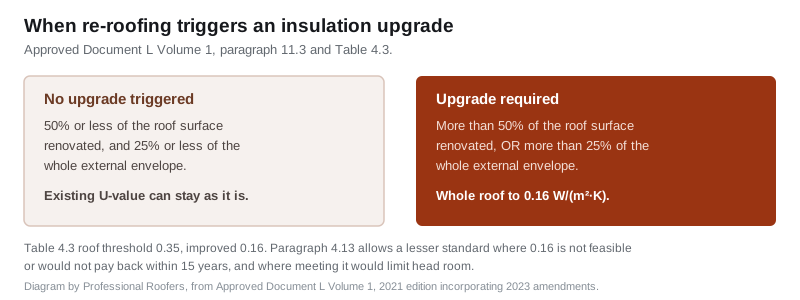
There are two escapes written into the document, and a good roofer will know both:
- If achieving 0.16 is not technically or functionally feasible, or would not pay back within 15 years, the element should be upgraded to the lowest U-value that is feasible and does pay back within 15 years. A thermal element once upgraded should generally not be worse than 0.7 W/(m²·K).
- If meeting the standard would limit head room, a lesser standard may be appropriate, provided the insulation plus any required air gap is at least the depth of the rafters and the insulant chosen achieves the lowest practicable U-value.
So the answer you want is not “Part L doesn’t apply to re-roofing”. It is a contractor who says which of those applies to your roof and why, and prices it. The answer that should concern you is a quote that is silent on insulation altogether, because either the price will change later or the work will not comply. Our page on planning permission and building regs for a new roof covers the wider notification question.
On the quote itself
“Is scaffolding included, and for how long?” Scaffolding is a significant line item and a common source of dispute, particularly when a job overruns and the scaffold hire extends. Get the inclusion and the duration in writing. Our roof scaffolding cost page explains how it is priced.
“What exactly does the price include and exclude?” You want a written breakdown: stripping and disposal, battens, membrane, tiles or slates by named type, ridge and hip treatment, flashings, ventilation, scaffolding, and skip or waste removal. A one-line total for “new roof” is not a quote, it is a number.
“What happens if you find rot in the timbers?” Good answer: a stated rate for additional timber work and an agreement that anything beyond a defined allowance is discussed and approved before it happens. Worrying answer: silence, or “we’ll sort it out”. Unexpected timber repairs are the most common cause of a final bill exceeding the quote, and the fix is agreeing the mechanism now.
“Is the ridge being bedded in mortar or dry-fixed?” This is a small question that tells you a lot. Dry-fix ridge systems are mechanically fixed and are the current standard for new work. Mortar-bedded ridges on an exposed roof are what our ridge tile repair page exists for. A contractor who has an opinion here and can explain it is one who thinks about detail.
“What is the warranty, who backs it, and what voids it?” Good answer: a written workmanship warranty from the company with a stated period, plus the separate manufacturer’s warranty on the materials, and clarity that the two are different things. Under the NFRC scheme, registered contractors offer an insurance-backed guarantee, which survives the company ceasing to trade. That distinction is the whole point. Worrying answer: a long guarantee period with no paperwork. A 25-year guarantee from a company with two years of trading history is a number, not a protection.
“When can you start, and how long will it take?” A contractor who can start tomorrow in September is worth a question or two. Our page on how long a new roof takes and the roof replacement process step by step set out realistic durations.
Questions to ask yourself
- Have I got three quotes on the same specification? Comparing a quote for concrete interlocking tiles against one for natural slate tells you nothing about the contractors.
- Is the cheapest quote cheap because something is missing? Read the exclusions before the totals.
- Am I being rushed? Deposit pressure, today-only pricing and a contractor who happened to be working next door are the three oldest signals in the trade.
- Have I checked the company at Companies House? Two minutes, free, and it tells you how long they have really been trading and whether the director has a trail of dissolved companies behind them.
Our companion guide on how to find a good roofer covers where to look in the first place, and roof replacement questions goes deeper on the technical specification.
Frequently asked questions
What should a roofing quote include? A written breakdown, not a single figure: stripping and disposal, new battens, the membrane type, the tiles or slates by name, ridge and hip method, flashings, ventilation provision, scaffolding with its duration, and waste removal. It should also state what happens and at what rate if rotten timber is found once the roof is open.
Do I need building regulations approval to replace a roof? Usually yes in effect, because stripping a roof back to the structure and re-covering it counts as renovating a thermal element. If more than 50% of the roof surface is involved, Approved Document L expects the element to be upgraded to a U-value of 0.16 W/(m²·K), subject to feasibility and a 15-year payback test. A contractor registered with the NFRC Competent Person Scheme can self-certify the work.
How do I check a roofer is properly qualified? Ask for a competent person scheme registration number and look it up on the scheme’s own register rather than trusting a logo on a website. Ask for the public liability certificate by email and check the insured name matches the company on your quote. Then check the company at Companies House.
Should I pay a roofer a deposit? A deposit covering materials ordered specifically for your job is normal, particularly for slate or specialist tiles. A large deposit before anything is ordered is not. Never pay the full amount before the work is finished and you have inspected it, and pay by a method that leaves a record.
What are the warning signs of a bad roofer? Cold calling or a knock at the door, pressure to decide immediately, a request for cash, a verbal quote with no written breakdown, no ladder used during the survey, and no interest in looking in the loft. Any one of those is a reason to get another quote; two together is a reason to stop.
How many quotes should I get for a new roof? Three, on an identical specification. If one is far below the others, the usual explanation is a different material, no scaffolding allowance, or no insulation upgrade, rather than a better price. Ask that contractor what is excluded before assuming you have found a bargain.
Want costs like this each month?
Join the Roofline brief for current UK prices and quote-reading tips.
More from Professional Roofers
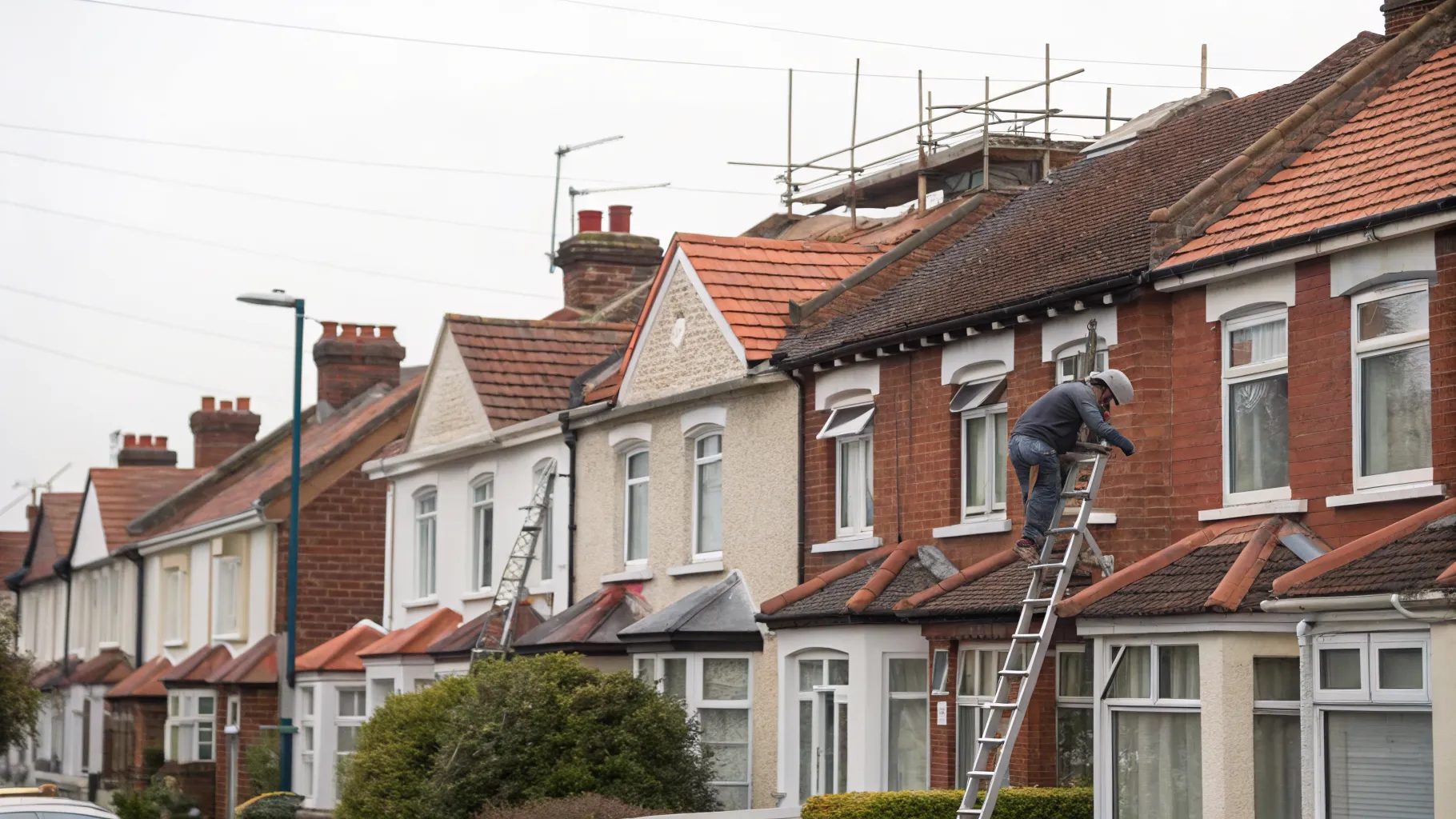
How Much Does a New Roof Cost in the UK in 2026?
What a new roof really costs in the UK in 2026, broken down by house size, material and the hidden extras, plus how to check you are being quoted fairly.
Chimney Repointing and Repair Cost UK (2026)
What chimney repointing cost is in the UK in 2026, why scaffolding drives the price, and how repointing compares to rebuilding, flashing and pot repairs.
Roof Inspection and Survey Cost UK: What's Checked and the Price
Roof inspection cost UK 2026: what a ground, ladder or drone survey checks, typical prices for each, and when a written roof report is worth paying for.