How Long Does a New Roof Take to Install?
By the Professional Roofers team
Updated 2026 · Independent cost guide
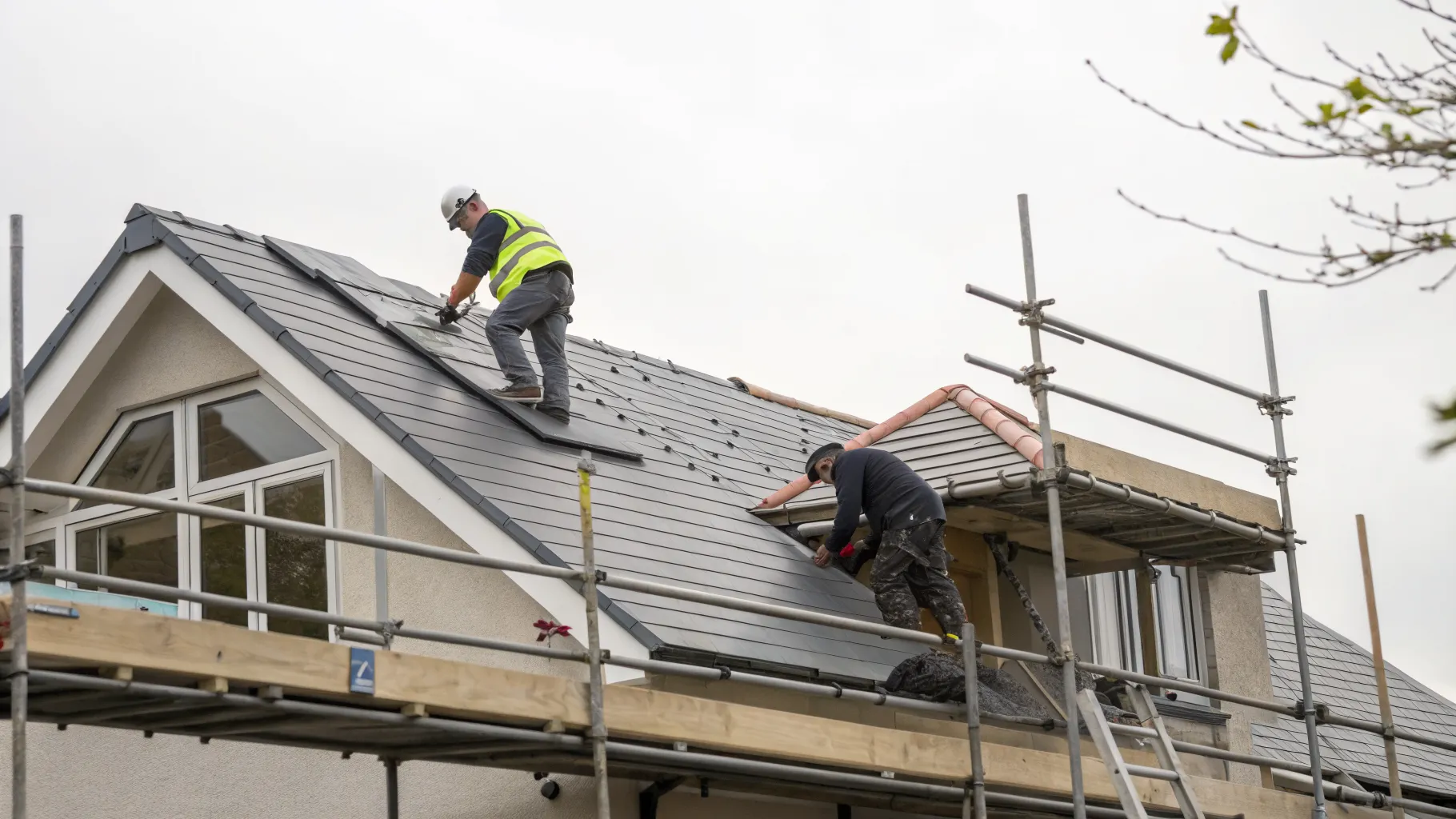
The actual roofing work on a typical UK pitched roof, a 3-bed semi-detached with concrete tiles, takes about 3 to 5 working days. That is the number most roofers quote, and it is accurate for hands-on-the-roof time. The number you should actually plan your life around is longer: once you add scaffolding, weather days and any timber repairs found after stripping, a full re-roof commonly runs 1 to 3 weeks from start to finish.
That gap between “install days” and “calendar time” trips up almost everyone. Homeowners are told five days, then the job stretches past two weeks, and nobody explained why. Below is the realistic timeline for each property type and covering, a day-by-day breakdown of what actually happens, the regulations that can add time, and what you can do to keep the job on schedule.
How long a new roof takes by property type
These figures are for pitched roofs being stripped and recovered in tile or slate. They are the install time on the roof, not the full project span.
| Property | Install time (working days) |
|---|---|
| Garage, extension or small flat roof | 1 to 2 days |
| Small terraced house | 2 to 4 days |
| Average 3-bed semi-detached | 3 to 5 days |
| Detached or larger roof | 6 to 10 days |
| Commercial or highly complex roof | 1 to 3 weeks |
Across UK roofers, the standard residential range quoted is 3 to 7 days. A semi sits in the middle of that. The spread exists because no two roofs are identical: more valleys, dormers, chimneys and hips mean more cutting, more flashing and more leadwork, and each of those adds hours.
If you want the cost side of the same job, our breakdown of roof replacement cost for a 3-bed semi lines up with these install times.
How the roof covering changes the timeline
The material you choose has a direct effect on speed, and the difference is bigger than most people expect.
- Concrete tiles are the fastest pitched option. They are large format, easy to cut and shape, and lay at a predictable pace.
- Clay tiles run at a similar speed to concrete, with slightly more care needed on handling and cutting.
- Natural slate is the slowest pitched covering. Slates are smaller, more fragile, and traditionally each one is holed and nailed by hand and placed carefully. Expect a slate roof to take noticeably longer than the same roof in tile. It is skilled work and you are paying for time as much as material.
Flat roofs are a different job and usually quicker overall, typically 1 to 3 days for a whole roof:
- EPDM rubber, for example a roughly 20m² extension, installs in about 1 to 2 days. It goes down as a single membrane with nothing to cure.
- GRP fibreglass takes longer for the same area, around 2 to 3 days, because it is built up in multiple layers with resin that has to cure between coats. Curing is temperature and weather sensitive, so it needs dry, not-too-cold conditions. Push it in the wrong weather and the finish suffers.
- Felt (built-up) goes down quickly in stable, dry weather.
If you are still choosing a covering, our guides to the best flat roof material in the UK and flat roof versus pitched roof cost go into the trade-offs in detail.
What happens day by day
Here is the order of work on a standard pitched re-roof, with rough durations. This is also why the job spreads beyond the headline install figure.
- Survey and quotation: 1 to 2 hours, usually a separate visit days or weeks before work starts. A proper survey is where structural surprises get spotted and priced, so do not skip it.
- Scaffolding erection: about 1 day. Scaffold must be up before any roof work begins, and it is often a separate company on its own schedule.
- Stripping the old roof: 1 to 2 days, removing tiles or slates, battens and old felt.
- Structural and timber repairs: variable. Rotten rafters, damaged timbers or failed decking are frequently only found once the roof is open. A run of new timber can add a day or more.
- Installing the new covering: 2 to 5 days. Breathable membrane or underlay, battens, then tiles or slates, plus ridge, hips and flashings.
- Finishing: about 1 day. Ridge tiles bedded or dry-fixed, flashings, leadwork around chimneys, and verges.
- Clean-up and inspection: roughly half a day.
- Scaffolding removal: this can lag the finish by several days, again because it depends on the scaffold company’s diary, not your roofer’s. It is a common source of frustration: the roof is done but the scaffold sits there.
For a fuller walk-through of each stage, see our roof replacement process, step by step.
A realistic worked example
A 3-bed semi, concrete tile re-roof, booked for mid-spring with no major structural issues:
- Day 1: scaffold erected
- Days 2 to 3: strip the old roof, membrane and battens go back on the same areas as they are cleared so nothing is left fully open
- Days 4 to 6: lay the new tiles, ridge, flashings and leadwork
- Day 7: finishing and clean-up
- Around day 9: scaffold removed
That is roughly nine days of calendar time for five days of roofing. Add a couple of wet days or a length of rotten rafter, and you are at two weeks without anything having gone wrong.
The regulations that can add time
This is where many homeowners get caught out, because most re-roofs are simpler than people fear but a few carry extra steps.
Building Regulations and the 50% rule
You normally need Building Regulations approval if you replace more than 50% of the roof covering, because that counts as renovating a “thermal element”. Approval is also triggered if the work affects more than 25% of the building envelope, if you make structural changes, increase the roof’s weight, or change its fire performance.
When the 50% thermal-element trigger applies, you have to upgrade the insulation to current standards, even when you are recovering like for like. Under Approved Document L (Part L), an upgraded pitched roof with insulation at ceiling level targets a U-value of around 0.16 W/m²K. That insulation work can extend the job.
There is also a material downgrade rule: if you switch to a covering that performs worse than the existing one, you need approval even if the work affects less than 50% of the roof.
Approval can be handled two ways. Either your contractor is registered under a Competent Person Scheme, for example an NFRC CPS member who self-certifies the work, or the job is submitted to Local Authority Building Control. The CPS notification and sign-off is the quicker route and is built into how a registered roofer works. The Local Authority Building Control guidance on building regulations for existing roofs sets out exactly when approval is required.
Planning permission (usually not needed)
Most re-roofing is permitted development and needs no planning permission, as long as you are not materially altering the external appearance. New tiles or slates should match the existing roof in colour, weight and style as closely as possible.
Planning permission is likely to be required if the property is listed, sits in a conservation area, or you are significantly changing the roof’s profile, materials or appearance where it is visible from a public area. If any of those apply, factor in the approval timeline before work can start. The Planning Portal guidance on roofs is the place to check.
Why weather legally stops the work
Roofers are not being slow when they down tools in bad weather. Under Regulation 12 of the Work at Height Regulations 2005, scaffolding used as a working platform must be inspected before first use, at least every 7 days while in use, and after any event that could affect its stability, such as high winds, heavy rain, snow or ice. Those inspection records are kept for at least three months after the work is complete. The Health and Safety Executive sets this out in its work at height guidance for construction.
So when a storm blows through, work stops and the scaffold often has to be re-inspected before anyone goes back up. That is a legal safety duty, which is why winter and unsettled spells stretch the calendar even when the roofing itself is straightforward.
There is also a moisture-management standard, BS 5250:2021, covering roof ventilation and breathable membranes to control condensation. It is part of why the underlay and ventilation detailing cannot be rushed.
What you can control to keep the job on schedule
Plenty of the timeline is outside your hands, but a few decisions genuinely move the needle:
- Book the scaffold early. Scaffolding lead time, both putting it up and taking it down, is one of the biggest sources of delay. Confirm dates with the scaffold company, not just the roofer.
- Get a proper survey done. Structural surprises are the main thing that blows the estimate. A thorough survey means rotten timber is priced and ordered in advance rather than discovered mid-job.
- Allow a weather contingency. If you are booking in autumn or winter, plan for extra days. Do not schedule it tight against an event you cannot move.
- Choose your covering with timing in mind. Concrete tile is the quickest pitched option; slate and GRP take longer for understandable reasons.
For the wider budgeting picture, our guide to new roof cost in the UK for 2026 covers how these timing factors feed into the quote.
Frequently asked questions
How long does a new roof take on a 3-bed semi? Around 3 to 5 working days of actual roofing. Plan for 1 to 2 weeks of calendar time once scaffolding, finishing and clean-up are included, and longer if the weather turns or timber repairs are needed.
Why does it take 2 to 3 weeks when the roofer said 3 to 5 days? The 3 to 5 days is hands-on roofing time only. The full project also includes scaffold erection before work starts, weather days when work has to stop, any structural repairs found after stripping, and scaffold removal that often lags the finish by several days. Homeowners regularly report two to three weeks for jobs originally described as about a week.
Can I live in the house while the roof is replaced? Usually yes. Expect loud noise, vibration and dust, and restricted access to the garden and any outdoor space under the work. Many people choose to be out during the noisiest stripping days, but staying put is normal.
Can a roof be replaced in winter? Yes, but expect more weather delays. GRP resin and some adhesives need dry, warmer conditions to cure, and work stops in high winds, heavy rain, snow or ice. A good roofer weatherproofs any exposed areas temporarily at the end of each day.
How long is my roof left exposed to the rain? Less than people fear. Competent roofers strip and recover in sections, getting membrane back on the same day an area is cleared, so the roof is rarely fully open. On a longer job it is common for only a day or two of genuinely full exposure to occur across the whole project.
Does slate take longer than tile? Yes. Slate is smaller, more fragile and traditionally holed and nailed by hand, so it is slower and more skilled work than laying concrete or clay tiles of the same roof area.
How long does a flat roof take? Typically 1 to 3 days. EPDM rubber is the quickest at about 1 to 2 days, GRP fibreglass takes 2 to 3 days because of its layered build and resin curing, and felt is quick in dry, stable weather.
How long from signing the quote to work starting? This is separate from the install time. Booking and scaffolding can mean a lead time of several weeks before anyone is on the roof, so ask for the start date and the install duration as two distinct figures.
Do I need planning permission or building regulations approval? Most re-roofs are permitted development and need no planning permission. Building Regulations approval is required once you replace more than 50% of the covering, make structural changes, or downgrade the covering’s performance. Listed buildings and conservation areas have their own rules to check first.
Want costs like this each month?
Join the Roofline brief for current UK prices and quote-reading tips.
More from Professional Roofers
How Much Does a New Roof Cost in the UK in 2026?
What a new roof really costs in the UK in 2026, broken down by house size, material and the hidden extras, plus how to check you are being quoted fairly.
Chimney Repointing and Repair Cost UK (2026)
What chimney repointing cost is in the UK in 2026, why scaffolding drives the price, and how repointing compares to rebuilding, flashing and pot repairs.
Roof Inspection and Survey Cost UK: What's Checked and the Price
Roof inspection cost UK 2026: what a ground, ladder or drone survey checks, typical prices for each, and when a written roof report is worth paying for.