Roof Valley Replacement Cost: £400 GRP to £1,200 Lead
By the Professional Roofers team
Updated 2026 · Independent cost guide
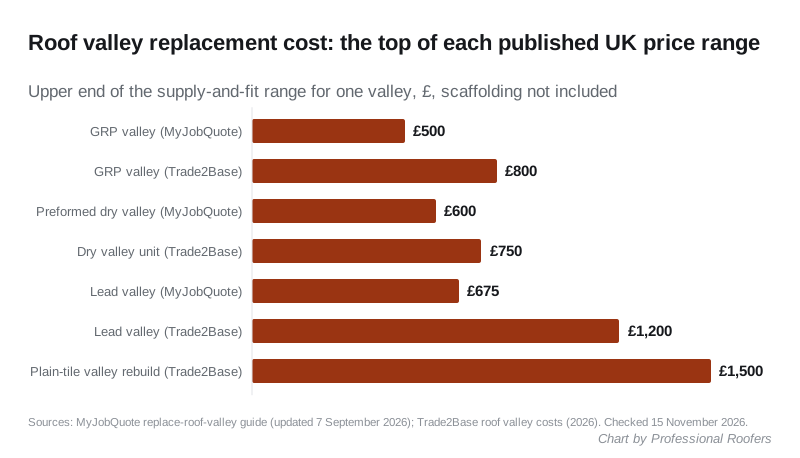
The roof valley replacement cost on a typical UK house is a few hundred pounds to a little over a thousand per valley, before scaffolding. Two published price guides checked on 15 November 2026 put a full GRP valley at £400 to £500 (MyJobQuote) or £400 to £800 (Trade2Base), and a full lead valley at £550 to £675 or £600 to £1,200. MyJobQuote’s average for a full valley replacement is £540, and it reckons the job takes six to eight hours.
Those ranges are wide because the price is set less by the lining than by four other things: how long the valley is, how many tiles have to come off each side, what state the boards underneath are in, and how the roofer gets up there. This page explains each one, so you can read a quote line by line. For the difference between the lining types themselves, see our roof valley types compared.
Published prices for a roof valley
| Job | MyJobQuote (updated 7 Sept 2026) | Trade2Base (2026) |
|---|---|---|
| Small repair to a lead valley | £90 to £225 | |
| Full replacement, lead valley | £550 to £675 | £600 to £1,200 |
| Re-line an existing lead valley | £500 to £900 | |
| Full replacement, GRP valley | £400 to £500 | £400 to £800 |
| Full replacement, preformed or dry valley | £500 to £600 | £350 to £750 |
| Re-point or re-bed a mortar valley | £200 to £500 | |
| Full rebuild of a plain-tile laced or swept valley | £800 to £1,500 |
Trade2Base also gives per-metre rates: £55 to £100 a metre for GRP, £90 to £160 a metre for lead and £45 to £90 for dry valley units. These are national guides built from quotes and trade surveys, not a price list. Use them to spot a quote that is far outside the norm, not to haggle a roofer down to the bottom figure.
Scaffolding is extra in both guides. MyJobQuote’s guide says plainly that a sloping-roof valley job is expected to need scaffolding, and that the amount depends on how hard the roof is to reach. On a two-storey house it can be a large share of the total bill. Our roof scaffolding cost guide explains what drives that figure and what a scaffold quote should list.
What a full valley replacement includes
A proper replacement is not just a new strip of lead or GRP. The roofer has to take apart the roof on both sides of the valley to reach it, and everything that comes off has to go back on correctly. A complete job should include:
- Stripping the tiles each side. Usually the cut tiles along the valley edge and at least one full tile beyond them, on both slopes, all the way from the ridge to the gutter. They are stacked for reuse.
- Removing the old lining, whether lead, GRP or a mortar bed.
- Checking and replacing the valley boards. These are the timber boards the lining sits on. After years of a slow leak they are often soft, and new boards add materials and time.
- New underlay across the valley, lapped under the existing underlay on each slope.
- Tilting fillets and the new lining, fitted with the correct laps for the roof pitch.
- Re-laying the tiles, with the cut tiles along the valley re-cut where needed and mechanically fixed. Since BS 5534 was revised in 2015, every tile on a new or renewed roof area should be clipped, nailed or screwed, so tiles held only by mortar are no longer good practice.
- Bedding or dry-fix finish along the valley edge, depending on the system.
- Clearing away the old lining and debris. Old lead has scrap value, and some roofers knock it off the price; ask.
A cheaper quote often leaves out the boards, the underlay or the tile fixings. If it says “replace lead in valley” and nothing else, ask what happens to each of these.
What pushes the price up or down
Valley length
A valley is always longer than the rafters either side of it, because it runs diagonally. On a house where two roofs of the same pitch meet at a right angle, the valley is about 1.2 to 1.3 times the length of the common rafter: roughly 1.22 times at 45 degrees and 1.29 times at 35 degrees. A roof slope with 4m rafters at 35 degrees has a valley of about 5.2m, not 4m. That is why per-metre rates matter more than a single per-valley price on large roofs.
Lead: the number of pieces
Lead in a valley cannot go in as one long sheet. It has to be laid in separate pieces no longer than 1.5m, each lapped over the one below, so it can expand and contract without splitting. The lap is 150mm at 30 degrees pitch and above, rising to 220mm at 20 degrees.
That changes the amount of lead you pay for. A 5.2m valley at 35 degrees needs four pieces: the first covers 1.5m, and each one after adds 1.35m once the lap is taken off. A 6m valley needs five. Valleys are normally lined in Code 4 or Code 5 lead, and Code 5 is the heavier and longer-lasting of the two, at 25.40kg per square metre against 20.41kg for Code 4. Our lead code numbers explained page has the full table.
GRP and dry valleys: the number of lengths
GRP valley troughs usually come in 3m lengths and are joined with an overlap, so a 5m valley needs two. The material is cheap: MyJobQuote puts GRP valley materials at £4 to £12 a metre. Most of a GRP quote is labour and access, which is why its total is not much lower than lead.
Access
How the roofer reaches the valley is often the biggest single variable. A single-storey extension valley might be done from a tower or ladders. A valley between two main roofs on a two-storey house needs a scaffold on at least one elevation, and a valley that ends at a parapet or above a conservatory roof may need more. Ask whether the scaffold is included, how long the hire runs, and what each extra week costs.
The state of the rest of the roof
On an old roof, stripping the tiles beside a valley often breaks a few, and discontinued tiles can be hard to match. If the roof is near the end of its life, the roofer may find the battens rotten too. A good quote says what happens if more damage is found, at what rate. Our page on matching discontinued roof tiles explains the options.
Lead or GRP: which is better value?
| Lead valley | GRP valley | |
|---|---|---|
| Published price, full replacement | £550 to £1,200 | £400 to £800 |
| Main failure | Splits at the laps if pieces are too long or fixed wrongly | Joints under-lapped on shallow roofs; debris build-up |
| Theft risk | Yes; lead is a target, and the valley is visible from the ground | None |
| Looks on a period or listed building | Expected; a conservation officer may insist on it | Usually not acceptable |
| Lifespan quoted | Decades if fitted correctly | Trade2Base suggests 25 to 40 years for a good GRP valley |
On an ordinary modern house, a GRP or dry valley is usually the better-value replacement: cheaper, no theft risk, and nothing to split. Lead is the right choice on older and listed buildings, on very wide valleys, and wherever the rest of the roof’s leadwork is being renewed at the same time. If your valley lead has been stolen, read lead stolen from roof before you decide, because insurers and replacement materials both come into it.
Repair or replace?
Not every leaking valley needs replacing. A blocked valley, a few slipped tiles or a short lap at one joint can often be repaired for a few hundred pounds. MyJobQuote’s repair ranges run from £60 for a small GRP repair to £225 for lead. Replacement makes sense when the lead is split in more than one place, the lining is worn through, the boards are rotten, or the valley has been patched repeatedly. Our guide to a leaking roof valley explains how to tell which you have from inside the loft, before anyone quotes.
Questions to ask on the quote
- Is scaffolding included, and for how long?
- How many tiles come off each side, and will the cut tiles be mechanically fixed when they go back?
- Are new valley boards and underlay included, or priced only if needed?
- What lining is being fitted: which code of lead, or which GRP or dry valley product?
- How many lead pieces, and what laps for this pitch?
- What happens if more damage is found, and at what rate?
- Is the old lead credited against the price?
- What guarantee is given, and is it insurance-backed?
The National Federation of Roofing Contractors lets you search for members who work to its code of practice, and is a sensible place to start if you need more than one quote.
Frequently asked questions
How much does it cost to replace a roof valley in the UK? Published 2026 guides put a full replacement at about £400 to £800 for GRP and £550 to £1,200 for lead per valley, with MyJobQuote’s average at £540. Scaffolding is extra, and on a two-storey house it is a large part of the bill.
How long does it take to replace a roof valley? MyJobQuote estimates six to eight hours for a full replacement and four to six hours for a repair. Allow longer if the boards are rotten, if tiles are hard to match, or if the scaffold has to go up first.
Is GRP cheaper than lead for a roof valley? Usually, but not by as much as the materials suggest. GRP troughs cost a few pounds a metre, but most of the price is labour and access, so on the published figures a full GRP valley comes in roughly £150 to £400 less than lead.
Do I need scaffolding to replace a roof valley? On most two-storey houses, yes. A low single-storey valley can sometimes be reached with a tower or ladders, but a main-roof valley needs a safe working platform, not a ladder alone.
Can a roof valley be repaired instead of replaced? Yes, if the problem is a blockage, a slipped tile, cracked mortar or one short lap. Replacement is needed when the lining is split in several places, worn through, or sitting on rotten boards.
Does home insurance pay for a new roof valley? Usually not for wear and tear, which is how most valleys fail. A policy may cover storm damage or stolen lead, depending on the wording, so check your policy before the work starts.
Want costs like this each month?
Join the Roofline brief for current UK prices and quote-reading tips.
More from Professional Roofers
How Much Does a New Roof Cost in the UK in 2026?
What a new roof really costs in the UK in 2026, broken down by house size, material and the hidden extras, plus how to check you are being quoted fairly.
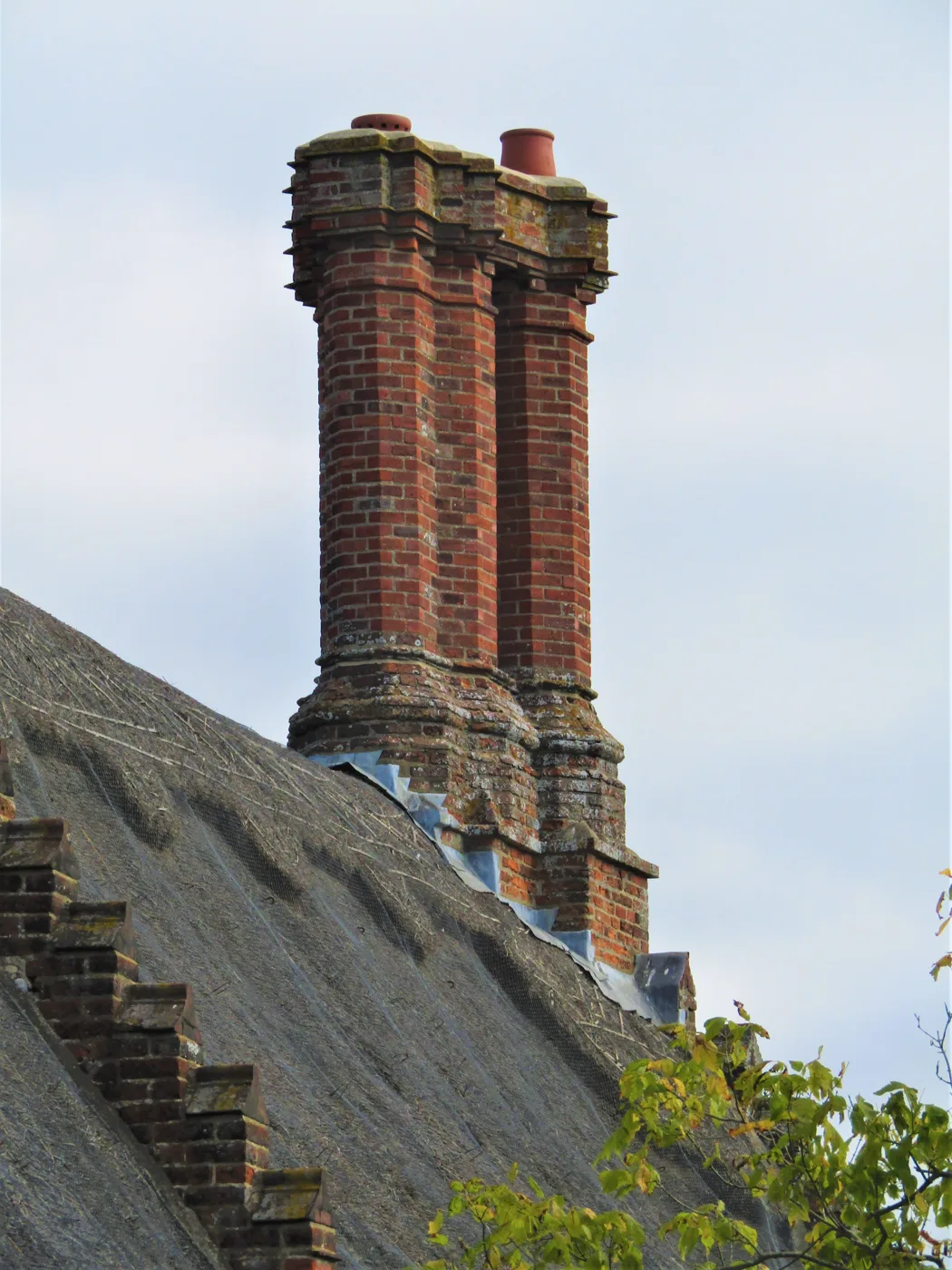
Chimney Repointing and Repair Cost UK (2026)
What chimney repointing cost is in the UK in 2026, why scaffolding drives the price, and how repointing compares to rebuilding, flashing and pot repairs.
Roof Inspection and Survey Cost UK: What's Checked and the Price
Roof inspection cost UK 2026: what a ground, ladder or drone survey checks, typical prices for each, and when a written roof report is worth paying for.