Roofing Guarantee vs Warranty: What Actually Pays Out
By the Professional Roofers team
Updated 2026 · Independent cost guide
A roofing guarantee printed on a quote is a promise from a company, and a promise from a company is worth exactly as much as the company. That is the whole subject in one sentence, and it explains why a twenty year guarantee from a two-man firm is usually worth less than a ten year one from a contractor who has bought insurance to stand behind it.
British homeowners get three different things called a guarantee, plus a set of statutory rights nobody can sign away, plus a Building Regulations certificate that has nothing to do with any of them but is the document a buyer’s solicitor will ask for. This page separates them.
The three things called a guarantee
1. The contractor’s workmanship guarantee. A contractual promise from the firm that fitted the roof, covering their labour. It typically runs 10 to 25 years and it is the one advertised in bold on the quote. It covers workmanship faults: bad flashing detail, tiles laid to the wrong gauge, a poorly formed valley. It is worthless the day the company stops existing, which is the fate of a large share of small building firms within a decade.
2. The manufacturer’s product or system guarantee. From the company that made the membrane, the tiles or the slates, covering the material against premature failure. These can be long, but they carry conditions: the product must have been installed to the manufacturer’s specification, often by an approved or trained installer, and the guarantee usually has to be registered within a set window after completion. A system guarantee, covering the whole build-up rather than one product, is stronger and is normally only available through approved installers.
Ask for the registration paperwork at handover, not in year three. An unregistered manufacturer guarantee is a leaflet.
3. The insurance-backed guarantee. A policy issued by an insurer that pays out if the contractor’s own guarantee cannot be honoured because the contractor has gone. This is the only one of the three that survives the firm.
What an insurance-backed guarantee actually does
An IBG is a double-trigger policy, and both triggers have to fire. The first is that the installing contractor has ceased to trade. The second is a defect caused by faulty workmanship within the guarantee period.
“Ceased to trade” has a specific meaning and it is narrower than most people assume. It covers liquidation, receivership, administration, winding up through bankruptcy, retirement at state pension age, and the death of the principals. It does not cover a contractor who is still trading but ignoring your calls. In that situation the IBG is not your route: your route is the contractor’s own guarantee and your statutory rights, and if necessary the courts.
The claims process is straightforward. You complete a claim form, and the insurer instructs a different contractor to inspect and report on the defect and the cost of putting it right. QANW, one of the main UK providers, sets out the mechanism on its own site. The premium is paid by the installer as part of the job, so if a quote offers an IBG, check the policy has actually been issued and that you have the certificate, not just the intention.
Your statutory rights, which are often the stronger claim
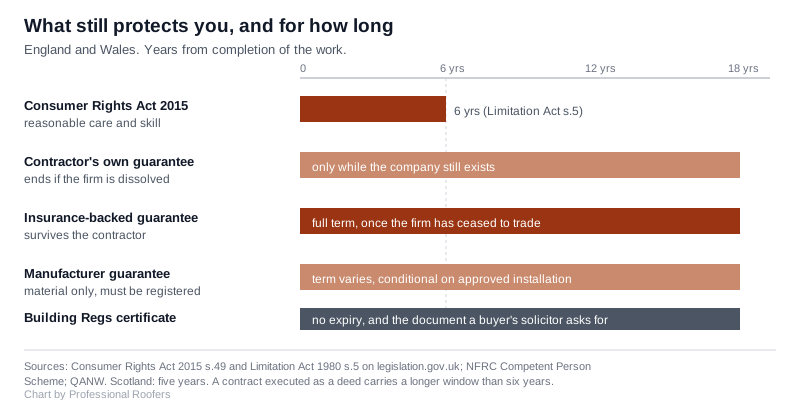
Two pieces of legislation sit under every roofing job for a consumer in England and Wales, and neither can be reduced by anything printed on a quote.
Section 49 of the Consumer Rights Act 2015 states that “every contract to supply a service is to be treated as including a term that the trader must perform the service with reasonable care and skill”. That is a statutory implied term. A roof that leaks because of poor workmanship is a breach of it, whatever the guarantee document says. You can read the section on legislation.gov.uk.
Section 5 of the Limitation Act 1980 then gives you the window: “an action founded on simple contract shall not be brought after the expiration of six years from the date on which the cause of action accrued”. Six years in England and Wales, five in Scotland. Where the contract was executed as a deed rather than signed as a simple contract, the window is longer.
Put those together and a useful test emerges. For the first six years you have a statutory claim that does not depend on the wording of any guarantee. The guarantee only starts doing work of its own in year seven, and only if the company is still there to honour it. That is why the years-on-the-certificate number is a poor way to compare quotes, and why the presence or absence of an IBG is a good one.
The certificate that is not a guarantee at all
Replacing a roof covering is usually notifiable work. Where 50% or more of the roof is being replaced, it is a legal requirement to notify Local Authority Building Control and comply with the Building Regulations, chiefly on insulation and on the ventilation of the roof space.
There are two legitimate routes. Either the job goes through a building control application in the normal way, or the contractor is registered with a Competent Person Scheme and self-certifies. For roofing, that scheme is the NFRC Competent Person Scheme. A registered contractor notifies the scheme when the work is taking place, and on completion the scheme notifies the relevant local authority, which produces the Building Regulation Compliance Certificate.
That certificate is the document that matters when you sell. A conveyancing solicitor acting for a buyer will ask for evidence of Building Regulations compliance for a re-roof, and the answer “the roofer gave us a twenty year guarantee” is not one. Retrospective regularisation is possible and it is slow, expensive and occasionally impossible.
Note what the scheme does not cover: it applies to refurbishment of 50% or more of a roof, not to repairs and not to new build. A patch repair or a few slipped tiles is not notifiable. Our page on planning permission and building regs for a new roof covers the thresholds in more detail.
What to ask before you sign
- Is the workmanship guarantee insurance-backed, and by which insurer? Ask for the provider’s name, not the word “insured”.
- When will the IBG certificate be issued, and will I receive it directly?
- Which manufacturer guarantees apply, for how long, and who registers them?
- Is this a product guarantee or a full system guarantee?
- Are you registered with a Competent Person Scheme, and will I get a Building Regulation Compliance Certificate?
- If not, who is making the building control application, and is the fee in this quote?
- What voids the guarantee? Look specifically for clauses about later work by others, storm damage, and moss removal or pressure washing.
- Does the guarantee cover consequential damage, meaning the ceiling and the decoration below the leak, or only the roof itself?
- Is the guarantee transferable to a buyer, and is there a fee or a notice period?
- How long has the company existed, and under how many company numbers?
Question 10 is not rudeness. Check the trading name at Companies House. A firm that has dissolved and reincorporated twice cannot meaningfully offer a twenty-five year guarantee, and the pattern is a genuine warning sign. Our guides to questions to ask a roofer and to spotting roofing scams go further on vetting.
The clauses that quietly remove the cover
Read the exclusions rather than the headline. The ones that catch people out most often:
- Maintenance conditions. Some guarantees require an annual inspection, sometimes by the issuing contractor, and lapse without the records.
- Work by others. Any later work touching the roof, an aerial bracket, a solar array, a satellite dish, a new soil vent, can void cover for the whole roof rather than the affected area.
- Weather. Storm damage is an insurance matter, not a workmanship matter, and every guarantee excludes it. That is legitimate, but it means the roofer will argue storm and you will argue workmanship on any wind-related failure.
- Existing structure. A guarantee usually covers the new covering, not the timbers underneath. If a defective rafter was left in place, the failure is arguably outside the guarantee.
- Transfer. Some guarantees end on sale of the property. If yours is transferable, transfer it properly at completion.
What to keep, and where
Put these in one place, digitally and on paper, and hand them over when you sell:
- The signed quotation and specification
- The invoice, marked paid
- The workmanship guarantee certificate
- The insurance-backed guarantee certificate and policy number
- The manufacturer guarantee registrations
- The Building Regulation Compliance Certificate
- Photographs of the roof structure taken while it was open, particularly the felt, battens, insulation and any timber replaced
That last one costs nothing and is the single most useful thing you can do on the day. It is the only record of what is under the tiles, and it settles most future arguments about whether a defect is workmanship or age. Related reading: how long a roof should last.
Frequently asked questions
What is the difference between a roofing guarantee and a warranty? In UK practice the words are used interchangeably, and neither has a fixed legal meaning. What matters is who stands behind the promise: the contractor, the material manufacturer, or an insurer. Ask which, rather than which word is printed on the certificate.
Is a 25-year roofing guarantee worth anything? Only if it is insurance-backed or the company is very likely to outlive it. An uninsured guarantee ends the day the firm is dissolved, and for the first six years your statutory rights under the Consumer Rights Act are usually the stronger claim anyway.
What does an insurance-backed guarantee cover? Defects caused by faulty workmanship, but only once the installing contractor has ceased to trade through liquidation, receivership, administration, winding up through bankruptcy, retirement at state pension age or the death of the principals. It is not a route against a contractor who is still in business.
How long do I have to make a claim against a roofer? Six years from when the cause of action accrued in England and Wales, under section 5 of the Limitation Act 1980, and five in Scotland. A contract executed as a deed carries a longer window. That runs independently of whatever the guarantee says.
Do I need Building Regulations approval to replace a roof? Yes, where 50% or more of the roof covering is being replaced. Either the contractor self-certifies through the NFRC Competent Person Scheme, which notifies the local authority and produces a Building Regulation Compliance Certificate, or a building control application is made. Small repairs are not notifiable.
Is a roofing guarantee transferable when I sell the house? Sometimes. Many are, occasionally for a fee and often only if the transfer is registered within a set period after completion. Others end on sale. Check the wording before you exchange, because it is a selling point when it transfers and an awkward question when it does not.
What voids a roofing guarantee? Most commonly: later work on the roof by anybody else, a missed annual inspection where the guarantee requires one, pressure washing or chemical moss treatment, and storm damage, which is excluded as an insurance matter. Read the exclusions before you agree the price, not after a leak.
Want costs like this each month?
Join the Roofline brief for current UK prices and quote-reading tips.
More from Professional Roofers
How Much Does a New Roof Cost in the UK in 2026?
What a new roof really costs in the UK in 2026, broken down by house size, material and the hidden extras, plus how to check you are being quoted fairly.
Chimney Repointing and Repair Cost UK (2026)
What chimney repointing cost is in the UK in 2026, why scaffolding drives the price, and how repointing compares to rebuilding, flashing and pot repairs.
Roof Inspection and Survey Cost UK: What's Checked and the Price
Roof inspection cost UK 2026: what a ground, ladder or drone survey checks, typical prices for each, and when a written roof report is worth paying for.