Roof Leak After Solar Panels? The Installer Usually Pays
By the Professional Roofers team
Updated 2026 · Independent cost guide
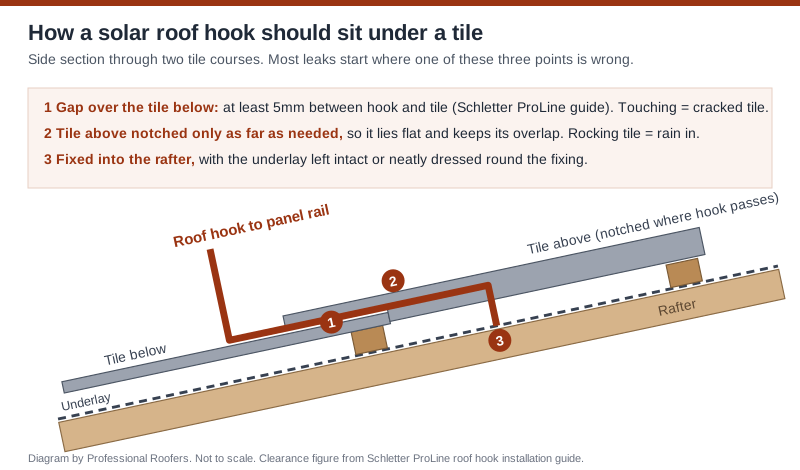
A roof leak after solar panels were fitted is almost always the installation, not bad luck. Every on-roof array is held up by metal hooks fixed through your roof covering into the rafters, typically dozens of them, and each one is a point where a tile has been lifted, cut and put back. If the leak started within a season or two of the panels going on, and the roof was dry before, start with the fixings.
The good news is that the installer is usually responsible, and there is now a clear complaint route through MCS if they will not put it right. This page covers the four usual causes, how to show it was the solar work, and who pays.
The four usual causes
1. Cracked tiles under the hooks. A roof hook runs from the rafter, under the tile above and over the tile below, then up to the panel rail. If the hook touches the tile below, any load on the panels (wind, snow, someone leaning on the array) presses the hook onto that tile and cracks it, often out of sight under the array. Schletter’s installation guide for its ProLine hooks says a minimum gap of 5mm must be kept between the hook and the tile underneath, and that the hook height must be chosen to suit the batten and tile so that gap can be kept.
2. Tiles above the hooks not sitting flat. The tile above each hook has to sit over the hook, so its underside is usually ground away where the hook passes. Ground too little and the tile rocks on the hook and lifts its tail, letting wind-driven rain under. Ground too much, or through the wrong part, and it loses the interlock or headlap that keeps water out. Schletter’s guide warns installers not to grind any deeper than the bar on the underside, and that improper machining of roof tiles can cause the roof to leak.
3. Slates and plain tiles treated like concrete interlocking tiles. Interlocking concrete tiles are the easiest roof for solar. Natural slate and small clay plain tiles are not: the hook has to pass through a much tighter lap, so slate roofs usually need a purpose-made slate hook with a flashing plate, or a replacement slate with a built-in flashing. A hook pushed between slates with nothing to weather it is a leak waiting for the first wet, windy week.
4. The cable entry. The DC cables from the panels have to get into the loft. A proper job uses a weathered cable entry tile or slate, or runs the cables down and in at the eaves. A hole drilled through a tile and filled with sealant, or cables pushed through the underlay at a tile joint, will leak. If the stain is near the inverter cable run, look here first.
How to tell it was the solar work
Before you contact the installer, gather the evidence. Most of it can be done from inside the loft.
- When did it start? A leak that appeared in the first autumn or winter after installation points at the work. Note the installation date and the first time you saw water.
- Where is the stain? Map it against the array. A stain under the panels, or on a rafter in line with them, fits a hook. One under the cable run fits the cable entry.
- Look up at the underlay with a torch on a wet day. Water tracking down a rafter from a fixing, a tear in the underlay at a hook, or daylight around a bracket are all clear signs. Take dated photos.
- Does it need wind? Hook leaks often only show in rain with a strong wind, when water is driven under a lifted tile. Our wind-driven rain leaks page explains the pattern.
- Rule out the usual suspects away from the array: valleys, flashings, chimneys and the ridge. Our how to find a roof leak guide works through them in order.
Do not go on the roof or lift panels yourself. Apart from the fall risk, disturbing the array can let the installer say you caused the damage.
Who pays
The installer, in most cases. Under the Consumer Rights Act 2015, a service must be carried out with reasonable care and skill. If it was not, you can ask the trader to put it right at no cost to you, and if they cannot or will not do so within a reasonable time, you can ask for a price reduction. Damaging the roof while fitting the panels is a clear example.
Their workmanship warranty. MCS-certified installers give a workmanship warranty, and installers who belong to a consumer code such as the Renewable Energy Consumer Code (RECC) must back it with insurance, so it still pays out if the firm stops trading. Check your paperwork for the warranty period and whether it covers damage to the roof covering, not just the panels and inverter.
Not usually your home insurance. Most policies exclude damage caused by faulty workmanship and gradual leaks. They may cover sudden water damage to ceilings and contents, but the insurer will then look to recover the cost from the installer. See our home insurance roof cover guide.
A roofer’s guarantee may be affected. If your roof was replaced recently, check the roofer’s guarantee before anyone else touches it. Schletter’s own guide notes that machining roof tiles regularly leads to the loss of the warranty for the roof covering. If the solar installer’s work voided your roofing guarantee, that is part of your claim against the installer. Our roofing guarantees page explains what those documents cover.
How to complain, step by step
- Write to the installer first. Describe the leak, when it started, where it is relative to the array, and attach your dated photos. Ask them to inspect and repair, and for the repair to include any damaged tiles, underlay and internal damage.
- Give them 14 days to respond. MCS will take over a complaint once you have complained to your MCS-certified installer and they have not responded after 14 days, or if you are unhappy with their answer.
- Escalate to MCS. MCS describes itself as the single point of contact for complaints about MCS-certified installers and installations. It handles complaints about quality of work and damage to property, can arrange a technical review, works with the installer on a fix, and can refer the case to an independent alternative dispute resolution (ADR) provider at its own cost. Start on the MCS consumer complaints page.
- Keep within the time limit. MCS says it cannot take complaints about installations completed over six years ago, or five years in Scotland.
- Paid on finance? A complaint about the loan itself goes to the finance provider and then the Financial Ombudsman Service; if you paid by credit card or a linked loan, the lender may also be jointly liable for a breach of contract.
MCS cannot make an installer pay compensation; its aim is to get the installation working properly. If you want money for internal damage, keep that claim alongside, and consider the small claims court if the installer refuses. MCS is moving all certified installers onto its redeveloped scheme by 31 March 2027, so the route may change slightly; check the page above when you complain.
What a proper repair involves
Expect the fix to need access to the array, which means scaffolding in most cases. A proper repair:
- lifts the panels at the affected hooks, or removes the row if several hooks are involved;
- replaces every cracked tile or slate, matching the profile (see matching discontinued roof tiles for older roofs);
- refits each hook with the correct clearance, packing the hook rather than grinding the tile below where needed, and notches the tile above so it sits flat;
- fits a proper slate hook or flashed slate on slate roofs;
- repairs any torn underlay at the fixings and replaces a sealant-filled cable entry with a weathered entry tile or slate;
- includes a water test or a check after the next heavy rain.
A smear of sealant around the hooks from a ladder is not a repair. If the installer sends a roofer, ask what they found at each fixing and get it in writing. Our questions to ask a roofer list helps.
Stopping it happening on your next install
If you are about to have panels fitted, these five questions avoid most of the problems above:
- Which MCS 012 certified mounting kit will you use, and is it certified for my roof covering?
- How will you keep the gap between each hook and the tile below?
- On slate or plain tiles: which slate or plain-tile hook and flashing will you use?
- Where will the cables enter the roof, and with what?
- Who warrants the roof against water getting in after the work, for how long, and is that warranty insurance-backed?
Our solar panels and your roof guide covers the structural checks MCS has required since June 2026, and why an ageing roof should be replaced before the panels go on.
Frequently asked questions
Can solar panels cause a roof to leak? The panels themselves do not, but the fixings can. Each roof hook passes under a tile and is fixed to a rafter, so a hook touching the tile below, a badly notched tile above or a poorly sealed cable entry can all let water in.
Who is responsible for a roof leak after solar panel installation? Usually the installer. Under the Consumer Rights Act 2015 the work must be done with reasonable care and skill, and MCS-certified installers give a workmanship warranty. Write to the installer first, then escalate to MCS if they do not respond within 14 days.
How long after solar panels are fitted can a leak appear? Often within the first autumn or winter, because hook leaks tend to show in wind-driven rain, and cracked tiles under hooks can take a while to open up. MCS will consider complaints about installations up to six years old, or five in Scotland.
Will my home insurance pay for a leak caused by solar panels? It may cover sudden water damage to ceilings and contents, but most policies exclude faulty workmanship and gradual leaks. The installer is the right first claim, and your insurer may pursue them anyway.
What can MCS do about a leaking solar installation? MCS can take on your complaint, arrange a technical review, work with the installer to fix the problem and refer the case to independent dispute resolution at its own cost. It cannot order the installer to pay compensation.
Should the installer grind the tile under a solar hook? Only the raised edge where needed, and only enough to keep the gap. Schletter’s guide sets a minimum 5mm gap between hook and tile, and says to remove only the bar on the underside of the tile above and not grind deeper. Packing the hook is often better than cutting the tile.
Want costs like this each month?
Join the Roofline brief for current UK prices and quote-reading tips.
More from Professional Roofers
How Much Does a New Roof Cost in the UK in 2026?
What a new roof really costs in the UK in 2026, broken down by house size, material and the hidden extras, plus how to check you are being quoted fairly.

Chimney Repointing and Repair Cost UK (2026)
What chimney repointing cost is in the UK in 2026, why scaffolding drives the price, and how repointing compares to rebuilding, flashing and pot repairs.
Roof Inspection and Survey Cost UK: What's Checked and the Price
Roof inspection cost UK 2026: what a ground, ladder or drone survey checks, typical prices for each, and when a written roof report is worth paying for.