Gutter Overflowing in Heavy Rain? 4 Causes and the Fix
By the Professional Roofers team
Updated 2026 · Independent cost guide
A gutter overflowing in heavy rain has one of four causes: it is blocked, it is too small for the roof above it, it is laid without enough fall (or sags) so water pools away from the outlet, or water from a roof valley is shooting over the front edge. Each looks similar from the ground, but the fixes are very different, and only one of them is solved by a gutter clean.
The way to tell them apart is to watch where and when it overflows. Go out in the next downpour with a coat and a torch and note the exact spot.
Where it overflows tells you why
| What you see | Most likely cause |
|---|---|
| Overflows in one spot, worse after autumn, even in moderate rain | Blockage at an outlet or in the downpipe |
| Overflows along a long stretch only in very heavy rain | Gutter too small for the roof area, or too few outlets |
| Water sits in the gutter after rain stops, overflows mid-run | Sag or back-fall: the gutter is not falling to the outlet |
| Water jets over the front at an inside corner | Valley discharge overshooting the gutter |
| Overflows at the outlet and the downpipe gurgles or backs up | Blocked downpipe, swan neck or gully |
1. Blocked gutter or outlet
This is the most common cause and the cheapest to fix. Moss washed off the tiles, leaves, and the granules that wear off concrete tiles and felt all collect at the outlet, which is the narrowest point. A partly blocked outlet copes with a drizzle and fails in a downpour, which is why many people think their gutter is too small when it is just dirty.
Check the downpipe too. If the gutter empties slowly even when clear, the blockage is lower down: in the swan neck (the offset bend under the eaves), at a shoe, or in the gully at ground level. Run a hose into the outlet and watch whether the water comes out at the bottom freely.
Fix: clear the gutter and outlets, rod the downpipe, and consider a leaf guard over the outlet if trees overhang the roof. Our gutter cleaning cost page shows what a professional clean with a vacuum and camera usually involves.
2. Gutter too small for the roof
A gutter has a fixed capacity. A large, steep roof sends more water into it, faster, than a small shallow one, and if the outlet is at one end of a long run the water has to travel the whole way along it.
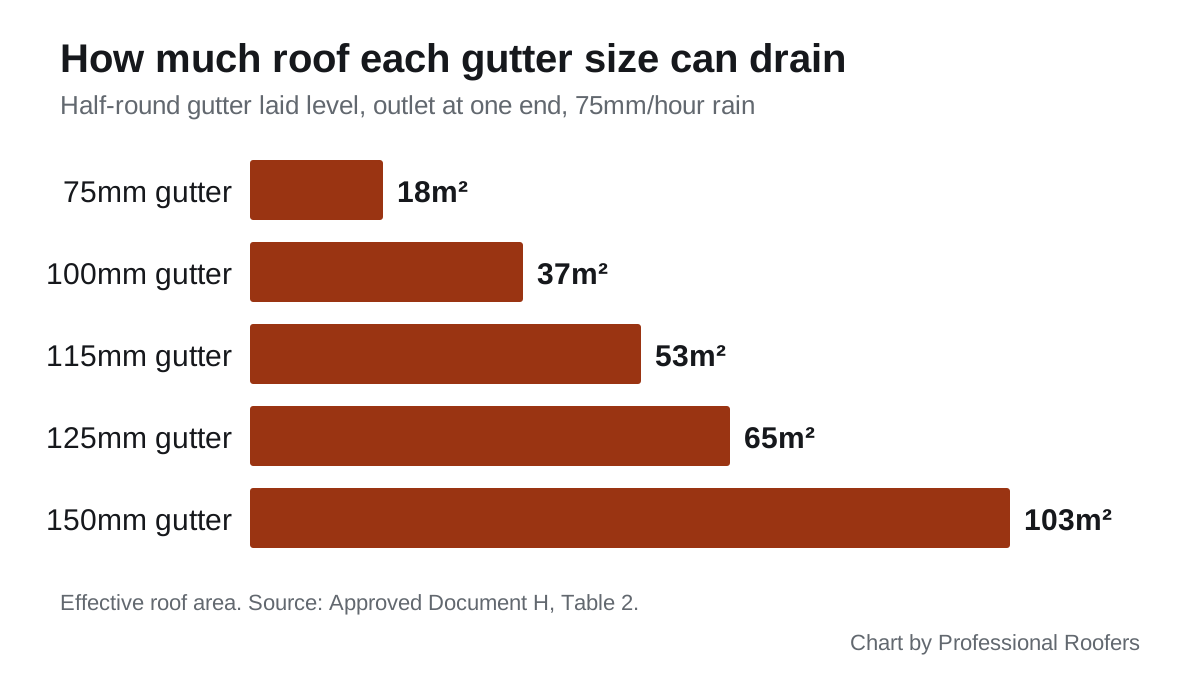
Approved Document H, the building regulations guidance on drainage in England, sizes gutters against a rainfall rate of 75mm an hour and gives the maximum roof area each size of half-round gutter can drain with a sharp-edged outlet at one end:
| Half-round gutter | Outlet | Max effective roof area |
|---|---|---|
| 75mm | 50mm | 18m² |
| 100mm | 63mm | 37m² |
| 115mm | 63mm | 53m² |
| 125mm | 75mm | 65m² |
| 150mm | 89mm | 103m² |
The “effective” area allows for pitch, because a steep roof catches more driving rain than its footprint suggests. Approved Document H multiplies the plan area (the roof’s footprint seen from above) by 1.29 for a 30 degree pitch, 1.50 for 45 degrees and 1.87 for 60 degrees.
A worked example: a rear roof slope 10 metres wide and 5 metres deep on plan, pitched at 45 degrees, has an effective area of 50m² x 1.5 = 75m². That is beyond what a standard 112mm to 115mm half-round gutter with one end outlet can drain (53m²). It would need a second outlet, an outlet in the middle of the run, a deep-flow profile or a bigger gutter. Our gutter size calculator runs this sum for your own roof.
Moving an outlet from the end to the middle roughly doubles how much roof the gutter can handle, because each half of the run only carries half the water. It is often the cheapest fix for a long run that overflows in storms, provided a new downpipe position works on the wall.
The table assumes a gutter laid level, so a gutter laid to a gentle fall towards its outlet has a small margin in hand. Read the guidance itself on GOV.UK.
3. Gutter laid flat, sagging or falling the wrong way
Plastic gutter brackets should be no more than about a metre apart, and closer where snow load or ladders lean on the run. When brackets break, fascia boards rot or a bracket was never fitted, the gutter dips. Water collects in the dip, adds weight, and the sag gets worse. In heavy rain the low spot overflows long before the outlet is full.
Signs: water standing in the gutter a day after rain, a visible wave in the line of the gutter from the ground, green staining or a drip line on the wall below one spot.
Fix: re-bracket and re-align the run so it falls gently towards each outlet. If the fascia behind is soft, that needs replacing first, or new brackets will pull out; see our fascia and soffit replacement cost page.
4. Water from a valley shooting over the gutter
Where two roof slopes meet at an internal corner, the valley gathers the water from both and delivers it in a fast jet at one point. In heavy rain that stream can overshoot the gutter completely, landing on the path or soaking the wall. The gutter is not full; the water simply never goes in.
Fix: a splash guard (a clip-on upstand fitted to the front of the gutter at the valley) turns the jet back into the gutter, and an outlet close to the valley stops that point being swamped. Our page on roof valley types explains why some valleys throw water harder than others.
When it is a joint, not an overflow
Water dripping from underneath the gutter rather than over the front is a leaking joint, not an overflow. The causes and fixes are covered in gutter leaking at the joint. If water is appearing inside the house, read why is my roof leaking, and for lead or asphalt-lined gutters behind a parapet see box gutter leaking.
What the fix usually involves
- Clean and rod: the first step in every case, and it solves most overflows.
- Re-bracket and re-align: for sags and back-falls on otherwise sound guttering.
- Extra outlet or downpipe: for long runs that are undersized, often cheaper than a whole new system.
- Deep-flow or larger gutter: for steep, large roofs where the existing gutter is genuinely too small.
- Full replacement: worth it when the plastic has gone brittle or the brackets and joints are failing along the whole run. Our guttering replacement cost page breaks down what drives the quote.
Falls from ladders are a real risk on gutter jobs. If the gutter is above single-storey height, use a contractor with scaffold or a tower.
Frequently asked questions
Why does my gutter overflow in heavy rain but not normal rain? Usually because a partial blockage at the outlet or in the downpipe limits how fast water can leave. In light rain it keeps up; in a downpour it cannot. If the gutter and pipe are clear, the gutter may be undersized for the roof or need a second outlet.
How do I know if my gutter is too small? Work out the roof’s effective area: footprint on plan multiplied by 1.29 for a 30 degree pitch or 1.5 for 45 degrees. Compare that with Approved Document H’s limits: 53m² for a 115mm half-round gutter with an end outlet, 37m² for 100mm. If your roof is bigger, the gutter is too small for its outlets.
Does a gutter need a slope? A fall towards the outlet helps it empty and adds capacity, and stops water standing. What matters most is that the gutter never falls away from the outlet or sags between brackets.
Will a gutter guard stop overflowing? Only if leaves and debris were the cause. Guards can make things worse in very heavy rain, as water can run over a mesh instead of through it. A guard over the outlet alone is often enough.
Can I fix an overflowing gutter myself? Clearing a single-storey gutter from a stable ladder is a reasonable DIY job. Re-aligning long runs, adding outlets or working on two storeys is safer left to a roofer or guttering contractor with proper access equipment.
Want costs like this each month?
Join the Roofline brief for current UK prices and quote-reading tips.
More from Professional Roofers
How Much Does a New Roof Cost in the UK in 2026?
What a new roof really costs in the UK in 2026, broken down by house size, material and the hidden extras, plus how to check you are being quoted fairly.
Chimney Repointing and Repair Cost UK (2026)
What chimney repointing cost is in the UK in 2026, why scaffolding drives the price, and how repointing compares to rebuilding, flashing and pot repairs.
Roof Inspection and Survey Cost UK: What's Checked and the Price
Roof inspection cost UK 2026: what a ground, ladder or drone survey checks, typical prices for each, and when a written roof report is worth paying for.