Fibre Cement Slates vs Natural Slate: 30 Years or 100?
By the Professional Roofers team
Updated 2026 · Independent cost guide
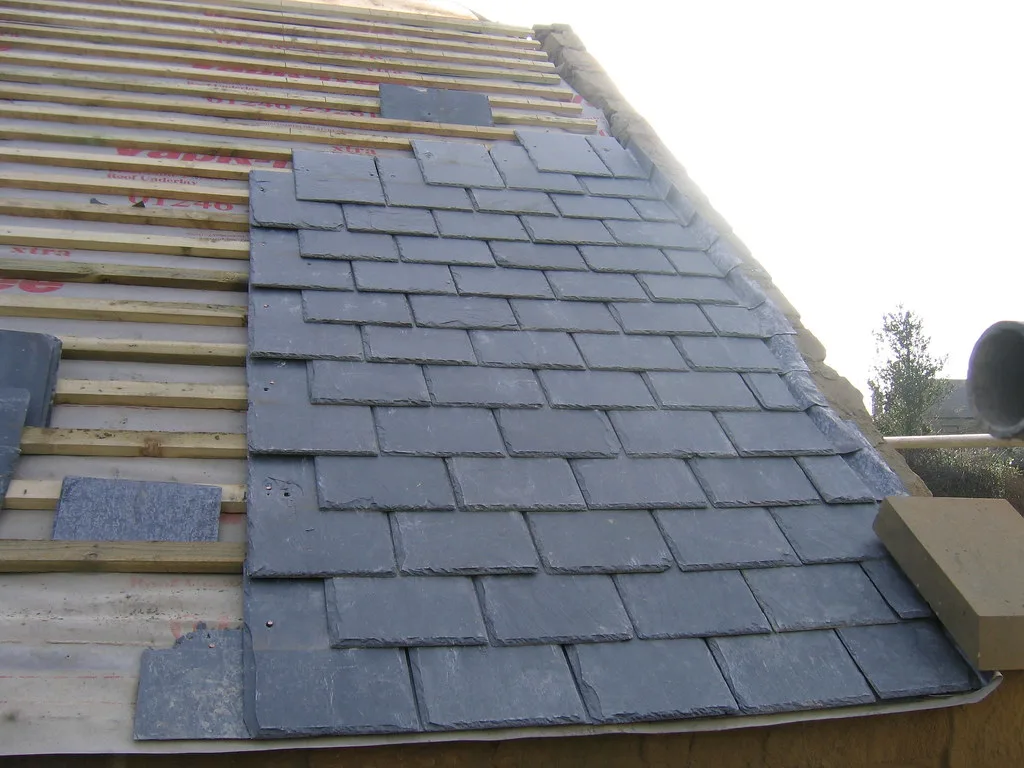
Choosing between fibre cement slates vs natural slate is mostly a question of how long you want the roof to last and how much the look matters. Fibre cement (man-made) slates are cheaper, uniform and quick to lay, and their makers have typically guaranteed them for around 30 years. A good natural slate, laid well, can last a century or more and can be lifted and reused when the roof is eventually stripped. The weight, the minimum pitch and the fixings are closer than most people expect. The real differences are life, appearance as the roof ages, and what your council will accept.
For what each option costs per square metre and for a whole roof, see our slate roof cost guide. This page is about which to choose.
The two products in plain terms
Natural slate is split from quarried stone. Most slate laid in the UK now comes from Spain, with Welsh slate (from quarries such as Penrhyn) at the premium end, plus slate from Brazil, China and elsewhere. Each slate varies a little in thickness and colour, and quality varies a lot between quarries. Natural roofing slate is tested to BS EN 12326, which grades it on things like how it copes with repeated wetting and drying (the thermal cycle test, graded T1 to T3) and how much water it absorbs.
Fibre cement slate is a manufactured sheet, usually about 4mm thick, made from cement reinforced with synthetic fibres and given a coloured coating. Two of the main ranges sold in the UK:
- Cedral Thrutone, formerly sold as Marley Thrutone: a smooth 4mm slate in 600 x 300mm and 500 x 250mm, in six colours, made to BS EN 492 (Cedral technical data).
- Swisspearl Westerland, formerly Cembrit Westerland: a 4mm slate with a riven, textured face and dressed edges designed to look closer to natural slate, with a water-based acrylic coating (Swisspearl).
If your roof was laid with “Marley” or “Cembrit” slates and you are trying to match them, ask your supplier for the Cedral or Swisspearl equivalent. Our page on matching discontinued roof tiles covers what to do if the exact product has gone.
Side by side
| Fibre cement slate | Natural slate | |
|---|---|---|
| Typical life | Makers’ guarantees have typically been around 30 years | Many decades; good Welsh slate 100 years or more |
| Thickness and size | Uniform, about 4mm | Varies slate to slate; thicker slates are heavier |
| Weight laid | About 20 to 23 kg/m² (Cedral Thrutone, 600 x 300mm, by lap) | Depends on thickness and source; thick slate is heavier than fibre cement |
| Minimum pitch | Set by each product’s data; Thrutone 20° to 25° depending on lap and exposure | BS 5534 generally sets 20° as the minimum for natural slate |
| Fixing | Two nails plus a copper disc rivet holding the tail | Two nails, or hooks on some roofs |
| Appearance as it ages | Coating weathers and colour can fade | Colour stays stable on good slate; weathers naturally |
| Reuse when stripped | Not normally reused | Sound slates can be reclaimed and relaid |
| Conservation areas and listed buildings | Often resisted on older buildings | Usually the expected like-for-like choice |
Lifespan: the biggest difference
This is where the choice is really made. Fibre cement manufacturers have typically guaranteed their slates for around 30 years, and a 2018 Cembrit technical document filed with a Camden Council planning application quoted 30 years for durability and 10 years for colour stability. In practice a well-laid fibre cement roof will often last longer than its guarantee, but it will not match a good natural slate.
Natural slate’s life depends almost entirely on quality. A top-grade slate (T1 in the thermal cycle test, with low water absorption) from a reputable quarry can last 100 years or more. A cheap slate with poor test results can rust where metallic inclusions sit in the stone, flake or crack far sooner. So “natural slate” alone tells you very little; ask for the quarry name and the BS EN 12326 test results before you accept a quote.
Over the life of the house, a good natural slate often works out cheaper per year than fibre cement, even though it costs more on day one. If you plan to stay for decades, or you are re-roofing a period house, that matters. If you are selling in five years or roofing an extension or outbuilding on a budget, fibre cement is a perfectly sound choice.
Weight and the roof structure
People often assume natural slate is far heavier. The difference is smaller than that. Cedral gives about 20.4 kg/m² for Thrutone at a 100mm lap, rising to 22.8 kg/m² at 150mm. Thin natural slate laid at a normal lap is in the same broad range, while thick, heavy slate is considerably more.
That matters if you are replacing concrete tiles, which are heavier still, with either type: the lighter roof is fine for the structure. It also matters in reverse. If a roof was built for lightweight slates, putting heavy thick slate on it may need a check by a surveyor or structural engineer. Our page on roof spread explains what happens when a roof structure is overloaded.
Minimum pitch and fixing
Both can be used on most UK pitched roofs, but check the product’s own data before a low-pitch job. For Cedral Thrutone at 600 x 300mm the minimum pitch is 20° to 25°, depending on headlap and how exposed the site is. For natural slate, BS 5534 generally sets 20° as the minimum, with steeper pitches, larger slates or bigger laps needed on exposed sites. Our minimum roof pitch guide has the detail by product type.
Fixing differs in one visible way. Fibre cement slates are light enough for wind to lift the tail, so each slate has a copper disc rivet that passes up between the two slates below and is bent over to hold the tail down. You will see the small copper discs on a finished fibre cement roof. Natural slates are nailed, either at the head or near the centre. In both cases the fixings must meet BS 5534; see our explainer on BS 5534 fixing.
How they look, new and in 20 years
When new, a good fibre cement slate looks crisp and even, and textured ranges like Westerland are made to resemble riven natural slate. From the street on a modern house, many people cannot tell the difference.
The difference shows with time and close up. Fibre cement has a uniform thickness, a coloured coating and straight edges, so the roof looks flatter and more regular. Over the years the coating weathers and colour can fade unevenly, especially on south-facing slopes. Natural slate has slight variations in thickness, texture and shade that give the roof depth, and good slate keeps its colour. On a Victorian terrace or a period cottage, that variation is part of the building’s character.
Planning, conservation areas and listed buildings
On an ordinary house outside a conservation area, you can normally re-roof with either material without planning permission. It gets more complicated in three situations:
- Listed buildings: changing natural slate to fibre cement will almost always need listed building consent, and councils usually expect like-for-like natural slate.
- Conservation areas: many councils resist man-made slate on older buildings in conservation areas, and where an Article 4 direction removes permitted development rights, changing the roof material can need planning permission.
- Matching neighbours: on a terrace, the council may care about the roofscape as a whole.
If either applies, talk to the council’s conservation officer before you order materials. Our page on planning permission and building regulations for a new roof has more.
A warning about old fibre cement roofs
If you are replacing an existing man-made slate roof laid before the end of 1999, the slates may contain asbestos. White asbestos was banned in the UK at the end of 1999, and older fibre cement slates often contained it. They should be tested before anyone cuts, breaks or removes them, and a licensed or competent contractor should handle disposal. Our asbestos roof removal guide explains the process.
Which should you choose?
- Choose natural slate for a period house, a listed building or conservation area, a roof you want to last for generations, or where the look matters most. Specify a good quarry and ask for the test results.
- Choose fibre cement for a budget re-roof, an extension, outbuilding or garage, a modern house where uniform looks suit, or a roof where weight is a concern.
- Avoid a cheap natural slate with no quarry name or test data. A poor natural slate can fail sooner than a good fibre cement one.
Frequently asked questions
How long do fibre cement slates last compared with natural slate? Manufacturers have typically guaranteed fibre cement slates for around 30 years, and many last longer. A good natural slate can last 100 years or more, but cheap natural slate can fail much sooner, so quality matters more than the label.
Are fibre cement slates lighter than natural slate? Usually, though by less than people think. Cedral Thrutone weighs about 20 to 23 kg/m² depending on lap. Thin natural slate is in a similar range, and thick natural slate is heavier.
Can you use fibre cement slates in a conservation area? Sometimes, but many councils resist them on older buildings, and a listed building will almost always need consent to change from natural slate. Check with the council’s conservation officer before ordering.
What is the copper disc on a fibre cement slate roof for? It is a disc rivet that holds the tail of each slate down so wind cannot lift it. Fibre cement slates are light and thin, so they need this extra fixing as well as two nails.
Is Marley Thrutone still available? The Thrutone slate is now sold under the Cedral brand as Cedral Thrutone. Cembrit Westerland is now sold as Swisspearl Westerland.
Do old fibre cement slates contain asbestos? Slates made before the UK ban at the end of 1999 may do. Have them tested before any work, and use a licensed or competent contractor to remove and dispose of them.
Sources
- Cedral, Thrutone Smooth technical data: thickness, sizes, colours, minimum pitch, weight, rivet fixing, BS EN 492.
- Swisspearl, Westerland slate: finish, coating, fixing.
- BS 5534 (slating and tiling for pitched roofs) and BS EN 12326 (slate for discontinuous roofing).
Want costs like this each month?
Join the Roofline brief for current UK prices and quote-reading tips.
More from Professional Roofers
How Much Does a New Roof Cost in the UK in 2026?
What a new roof really costs in the UK in 2026, broken down by house size, material and the hidden extras, plus how to check you are being quoted fairly.
Chimney Repointing and Repair Cost UK (2026)
What chimney repointing cost is in the UK in 2026, why scaffolding drives the price, and how repointing compares to rebuilding, flashing and pot repairs.
Roof Inspection and Survey Cost UK: What's Checked and the Price
Roof inspection cost UK 2026: what a ground, ladder or drone survey checks, typical prices for each, and when a written roof report is worth paying for.