Roof Cost Per Square Metre UK: How Roofers Price a Re-Roof
By the Professional Roofers team
Updated 2026 · Independent cost guide
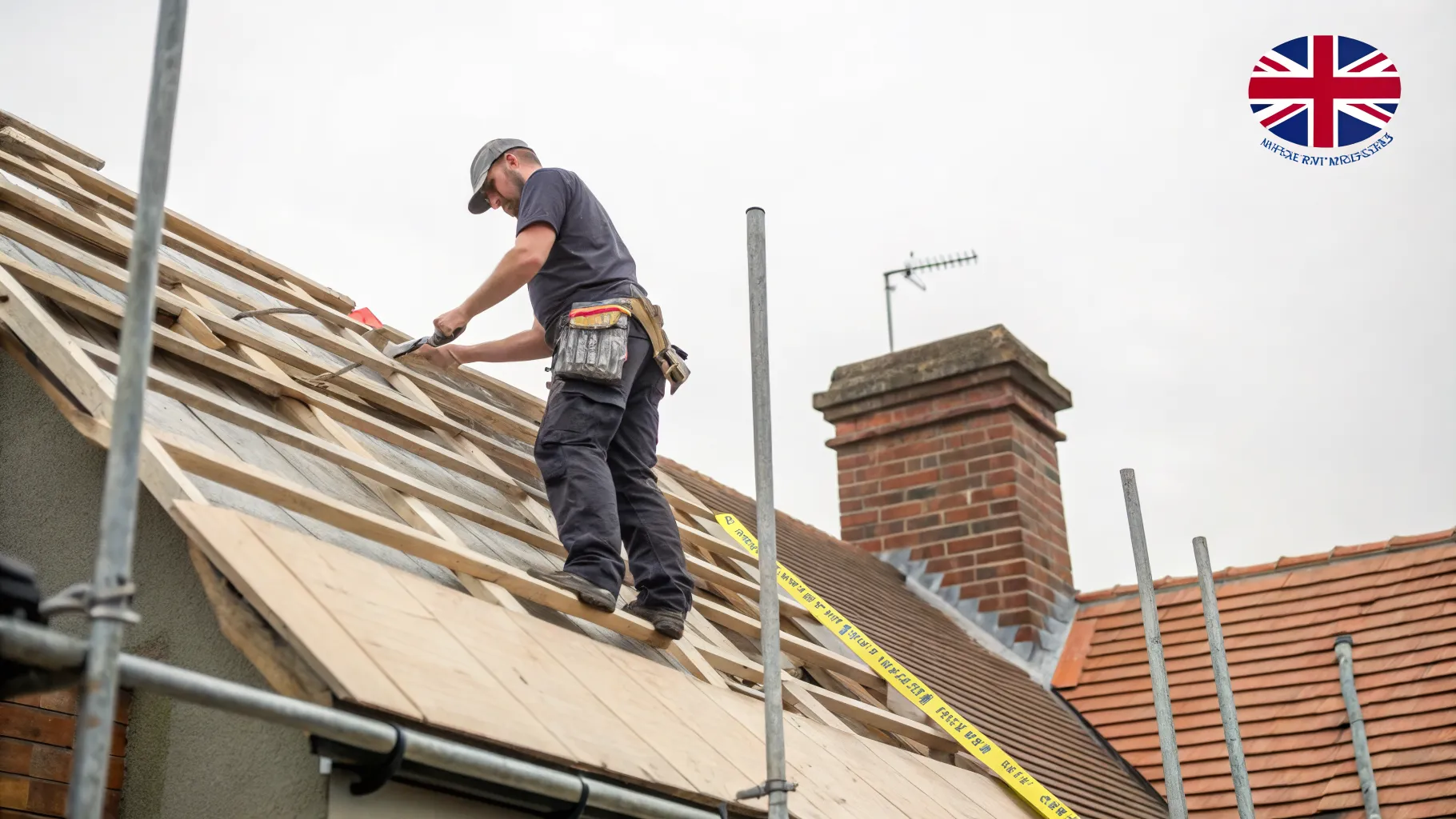
If you search for the roof cost per square metre in the UK, you will find tables that contradict each other, sometimes by a factor of two or three for the same material. The figures go stale, the ranges overlap, and none of them explain why your quote landed where it did. This page takes a different approach: instead of another table of numbers, it explains the pricing model roofers actually use, the multipliers that move a square-metre rate up or down, and how to read a quote line by line. Once you understand the formula, you can judge any quote, in any region, in any year.
The formula behind every re-roof quote
Almost every pitched re-roof is priced the same way, whether the roofer writes it out or not:
(strip rate + lay rate) x roof surface area + fixed lines (scaffold, skip, leadwork, prelims)
Four things in that formula do all the work:
- Roof surface area, which is bigger than your house footprint because of the pitch.
- The lay rate per square metre, which moves with the covering material and the complexity of the roof.
- The strip rate, a separate per-square-metre line for removing and disposing of the old covering.
- The fixed lines, dominated by scaffolding, which barely change whether the roof is concrete or slate.
As a rough rule of thumb, labour and materials take broadly similar shares of the final bill, with scaffold, skip hire and preliminaries making up the rest. That split matters when you compare quotes: a cheap quote has usually trimmed labour, the strip-out or the scaffold spec, not the tiles.
Step one: your roof area is not your floor plan
The most common reason homeowners think a per-square-metre figure looks wrong is that they multiply it by the footprint of the house. Roofers price the actual sloping surface, and the slope inflates the plan area.
The maths is simple: the pitch multiplier is the square root of one plus the rise-over-run squared. You do not need to calculate that yourself; the practical version is that most UK pitched roofs sit between about 30 and 45 degrees, which multiplies the plan area by roughly 1.15x to 1.4x. A steep Victorian roof at around 50 degrees can push past 1.5x, while a shallow modern estate roof at 22.5 degrees sits nearer 1.1x.
So a roof that covers a plan area of 60 square metres might be 70 to 85 square metres of actual surface to strip, felt, batten and tile. If an online guide’s “average semi” figure looks low next to your quote, check whether you are comparing surface area with footprint before assuming anything else. Our roof area calculator does the pitch conversion for you, and the roof replacement cost calculator builds the rest of the formula around it.
Step two: the material multiplier
Absolute prices change with the market; the relative gaps between materials are far more stable. Concrete interlocking tile is the baseline, the cheapest mainstream covering to supply and the fastest to lay.
| Covering | Rough cost vs concrete tile | Typical lifespan | Notes |
|---|---|---|---|
| Concrete tile | Baseline | 40 to 60 years | Cheapest to supply, fast to lay, heavy |
| Clay tile | Roughly 30 to 50% more | 60 to 100+ years | Better colour retention, often required in conservation areas |
| Natural slate | Roughly 60 to 90% more | 100+ years | Most expensive mainstream covering, slowest to fix |
| Felt / asphalt shingle | Below baseline | 15 to 25 years | Flat and low-pitch roofs only |
Three points the comparison tables online usually miss:
- Heavier materials cost more twice. Slate and concrete raise the disposal and skip line as well as the supply line, because the strip-out produces heavier waste.
- Lifespan changes the real cost. Slate at nearly double the price of concrete, lasting roughly twice as long or more, is often the cheaper covering per year of service. Whether that matters depends on how long you plan to own the house.
- Reclaimed tiles can cut the materials bill. Sound clay tiles and slates can sometimes be sorted and relaid, saving on supply but adding sorting labour, so the saving is smaller than it first looks. Ask the roofer to price both options if your existing covering is good.
Step three: the complexity multiplier
A per-square-metre rate assumes a plain two-plane gable roof. Real roofs rarely cooperate. Hips, valleys, dormers, chimneys with leadwork, rooflights and multiple small roof planes all slow the job down, and the effect is large: as a roofer’s rule of thumb, a complicated roof can take roughly double the labour time of a plain gable roof of the same area.
This is the single biggest reason readers with period properties or dormered semis feel overcharged when they compare their quote to a national average. The average was priced on a rectangle. Every valley needs cutting and lining, every chimney needs flashings, and a roof carved into six small planes has far more perimeter and detail per square metre than one big slope. If your roof is complicated, expect the labour half of the formula to carry a multiplier well above 1, and treat that as normal rather than as padding.
Step four: the fixed lines, especially scaffold
Scaffolding is usually the largest line on the quote that has nothing to do with roofing. It moves with:
- Height and layout: a three-storey townhouse needs far more scaffold than a bungalow.
- Access: a mid-terrace with no side access, or a conservatory tucked under the eaves that has to be bridged, pushes the design and the price up.
- Scaffold licences: if the scaffold stands on a public footway or road, the contractor needs a licence from the council, and the licence and the management around it add cost, which is one reason city jobs run dearer.
You generally cannot avoid scaffold on a re-roof, and you should be wary of any quote that tries to. The fixed lines also explain why small roofs look expensive per square metre: the scaffold, skip and set-up cost roughly the same whether they are amortised over 40 square metres or 120.
Region is a real multiplier, not an excuse
Labour rates put London and the South East at the top of the national range, with parts of northern England and Northern Ireland generally below average. Trade and consumer forums show the gap clearly: London homeowners regularly report quotes from several firms that sit well above the national guide figures. Higher labour rates, council scaffold licences, parking and access all stack in cities. If you live in a high-cost region, compare your quotes against each other, not against a national table written from the cheapest end of the country.
Why your quote includes things your old roof never had
A modern quote is not pricing a like-for-like copy of the roof being removed, and this defuses a common rip-off suspicion.
BS 5534 dry fixing. The current British Standard for slating and tiling, BS 5534:2014+A2:2018, requires single-lap tiles and all ridge and hip tiles to be mechanically fixed; mortar alone is no longer compliant, and perimeter tiles must be twice-fixed. That is why your quote includes a dry ridge or dry verge system when the old roof just used mortar, and why a compliant re-roof costs more than the job it replaces. It is the standard, not an upsell.
Building Regulations and insulation. Re-covering a roof normally needs Building Regulations approval. The exemption only covers smaller repairs: broadly, work affecting less than a quarter of the building envelope and less than half of the roof, and changing to a significantly heavier or different covering needs approval in any case. Because the roof is a thermal element, the work should also include upgrading its insulation to current standards where that is technically and economically feasible; official guidance judges economic feasibility on a simple payback of 15 years or less. The detail is on the Planning Portal re-roofing page. A good quote either includes the building control fee or, better, comes from a contractor registered with the NFRC Competent Person Scheme, who can self-certify the work as compliant and save you that fee entirely.
Structural checks when changing material. If the new covering is significantly heavier or lighter than the old one, for example concrete tiles going onto a roof framed for slate, the structure may need checking and possibly strengthening by a structural engineer or surveyor. That assessment belongs in the quote, not as a surprise.
How to read a quote line by line
Forum threads comparing roofing quotes show the same pattern again and again: two quotes for the same roof differ widely because they cover different scopes. Before judging which is cheaper, make them comparable.
Check each quote states, item by item:
- Strip and disposal of the old covering (its own per-square-metre line, plus skip)
- New breathable membrane and new battens, not “re-use where possible”
- The covering, named by manufacturer and product, supplied and fixed to BS 5534
- Dry ridge and dry verge systems
- Leadwork: chimney flashings, valleys, abutments
- Scaffolding, including any council scaffold licence
- Building control fee or NFRC CPS self-certification
- What happens to fascias, soffits and guttering: included, excluded, or priced as an option
Know the jargon. “Supply and fix” means materials and labour together. A “provisional sum” or “PC sum” is an allowance for something not yet priced, often the leadwork or timber repairs; treat a quote full of provisional sums as less fixed than it looks.
Agree the contingency mechanism up front. Nobody knows the state of the battens and rafters until the roof is stripped. The fair approach is pre-agreed rates for replacing timber by the metre, written into the quote, rather than an open-ended day rate negotiated mid-job with your roof open. A quote with a stated contingency mechanism is safer than the lowest headline number.
Normalise for VAT. A VAT-registered firm adds VAT; a small sole trader may quote without it. That is a 20 percent apparent gap that says nothing about workmanship. Check whether each figure is inclusive before comparing.
Get two or three itemised quotes from established local firms; TrustMark and the NFRC directory are sensible places to find them. For benchmarks on whole-house jobs rather than rates, see our guides to the cost of a new roof in the UK and the cost of re-roofing a 3-bed semi.
Frequently asked questions
How do roofers measure a roof, is it the floor area of the house? No. They price the actual sloping surface. At typical UK pitches of about 30 to 45 degrees, the roof surface is roughly 1.15 to 1.4 times the plan area, so a quote based on surface area will always look high against a footprint estimate.
Why have I been quoted far more than the online guides say? Usually one of four things: you compared footprint with surface area, you live in a high-cost region such as London or the South East, your roof has complexity (hips, valleys, dormers, chimneys) that can double labour versus a plain gable, or the guide figure excluded VAT, scaffold or the strip-out.
Do I need Building Regulations approval to replace my roof? For a full re-roof, normally yes. The exemption only covers smaller repairs, broadly work affecting less than a quarter of the building envelope and less than half of the roof. Because the roof is a thermal element, the job usually includes upgrading its insulation to current standards where feasible. An NFRC Competent Person Scheme roofer can self-certify the work, which removes the separate building control fee.
Can my old tiles or slates be reused? Sometimes. Sound clay tiles and natural slates can be sorted and relaid, which saves on materials but adds sorting labour, so the net saving is modest. Concrete tiles at the end of their life are rarely worth saving. Ask for the job priced both ways.
What if the roofer finds rotten battens or rafters after stripping? Some timber surprises are normal. The protection is a contingency mechanism agreed in writing before work starts: pre-agreed rates per metre of replacement timber, not an open-ended day rate negotiated while your roof is open.
Why does my quote include dry ridge and dry verge when the old roof used mortar? Because BS 5534, the current British Standard for slating and tiling, requires ridge, hip and single-lap tiles to be mechanically fixed. Mortar bedding alone is no longer compliant, so a modern re-roof includes dry-fix systems as standard.
Want costs like this each month?
Join the Roofline brief for current UK prices and quote-reading tips.
More from Professional Roofers
How Much Does a New Roof Cost in the UK in 2026?
What a new roof really costs in the UK in 2026, broken down by house size, material and the hidden extras, plus how to check you are being quoted fairly.
Chimney Repointing and Repair Cost UK (2026)
What chimney repointing cost is in the UK in 2026, why scaffolding drives the price, and how repointing compares to rebuilding, flashing and pot repairs.
Roof Inspection and Survey Cost UK: What's Checked and the Price
Roof inspection cost UK 2026: what a ground, ladder or drone survey checks, typical prices for each, and when a written roof report is worth paying for.