Cost to Replace a Roof on a 3-Bed Semi-Detached House
By the Professional Roofers team
Updated 2026 · Independent cost guide
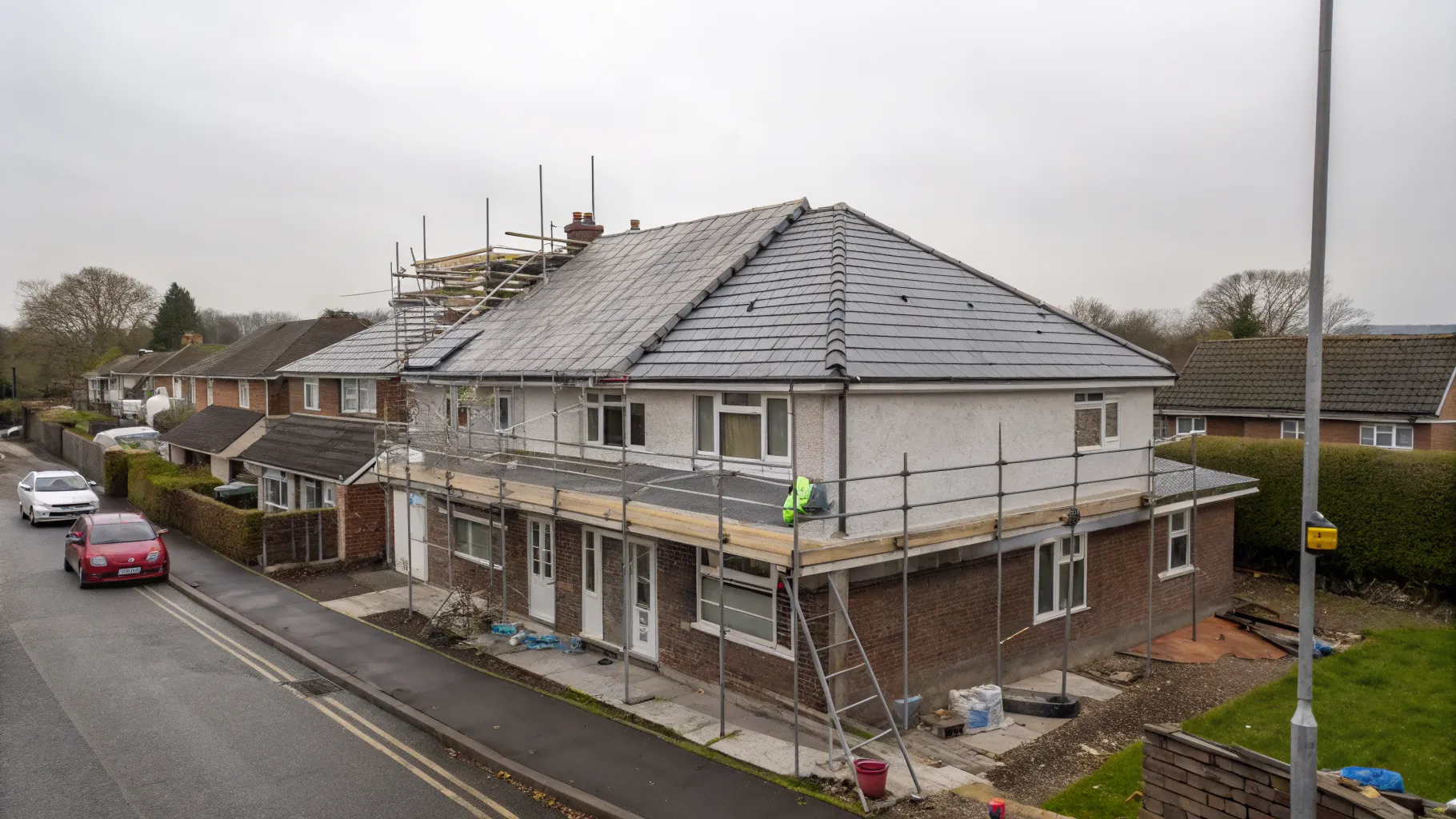
If your roof is leaking, shedding tiles into the garden or simply old, the first thing you want is a number. The honest answer for a typical three-bed semi is a range, not a single figure, because two things move the price hard: the tile you choose and where you live. This guide gives you realistic 2026 ranges, an itemised breakdown of where the money goes, and the checks that tell you whether a quote is fair or whether someone is trying it on.
The headline cost for a 3-bed semi in 2026
For a full re-roof in standard concrete tiles, which is the default choice on most semis, you are typically looking at roughly £6,500 to £14,500. Most homeowners replacing a standard concrete tile roof land somewhere in the £7,000 to £12,000 band once scaffolding, membrane, battens, labour, waste and VAT are all counted in.
The two big movers are material and region:
- Concrete tiles (typical default): roughly £6,500 to £14,500.
- Clay tiles: add around 25 to 40 per cent over concrete, so roughly £10,000 to £16,000.
- Natural slate: close to double concrete, roughly £13,500 to £21,000 and up.
- Lower end: a smaller, simpler gable-roofed semi, especially in the North West, can come in around £5,000 to £8,000. Treat that as the floor, not the expected price.
- London and the South East: run about 20 to 35 per cent higher. Inner London three-bed roofs commonly sit in the £11,500 to £22,000 range, with a two-bed terrace coming in lower.
These are indicative ranges drawn from cost-comparison sites and homeowner reports, not a quote. Get three written quotes for your specific roof before you budget firmly. For a wider view across roof types and sizes, see our new roof cost guide and the updated 2026 new roof cost breakdown.
How big is the roof on a typical semi?
This is the number everything else hangs off, and sources genuinely disagree, so here is the honest version.
- A simple gable-roofed semi (one main pitched roof, two slopes) is often quoted at 65 to 75 m².
- Once you add extensions, dormers, hips and both elevations, figures climb to 80 to 120 m².
A realistic working range for a typical semi is 70 to 90 m² of roof slope. The gap between the low and high figures is almost entirely about what gets included: the main roof only, or the main roof plus a rear extension, bays and dormers. When you read a cost guide quoting “£X for a semi,” check which roof area it assumed, because that single assumption can swing the total by thousands.
One point specific to semis: you only pay for your own half. The party wall runs down the middle, and your neighbour owns and pays for their side. That is the main reason a semi costs less to re-roof than a detached house of similar footprint. It also answers a common worry: no, you do not share the cost of re-roofing your half with next door.
In tile terms, expect roughly 2,000 to 4,000 tiles depending on type. Interlocking concrete tiles cover around 10 per m²; small plain tiles can need up to about 60 per m². Always add 10 to 15 per cent for wastage (cuts, breakages, future repairs).
Roof replacement cost on a 1930s semi: why it runs higher
A lot of the semis people search about are 1930s houses, and they rarely land at the bottom of the range. The reason is the shape of the roof. The typical 1930s semi was built with a pitched, ridged and hipped roof covered in plain clay tiles, with a bay window at the front, as this account of the 1930s house describes. Each of those details adds labour.
MyBuilder’s cost guide (updated 21 August 2026) puts the difference in plain numbers for a typical semi of 50 to 80 m²:
| Roof shape on a semi | Typical cost (MyBuilder, Aug 2026) |
|---|---|
| Gable end (two slopes, gable walls) | £5,000 to £8,000 |
| Hipped (all sides slope to the eaves) | £8,000 to £12,000 |
So a hipped 1930s semi typically costs around £3,000 to £4,000 more than a gable-ended semi of the same size, before you choose a dearer tile. Where that money goes:
- Cutting along the hips. On a gable roof the tiles run out to a straight verge. On a hip, every course has to be cut at an angle where two slopes meet, and the hip itself needs its own capping tiles bedded or dry-fixed down its length. That is slow, skilled work.
- The bay roof. The front bay usually has its own small roof, with its own tiling, flashing and often lead. It is a small area but it is fiddly, and it needs scaffolding at the front at ground level as well as at the eaves.
- Chimney stacks. Most 1930s semis have at least one stack on the main roof. New flashing around a stack is normally part of a proper re-roof, and our roof flashing repair cost page covers what that part costs on its own.
- Plain tiles, if you keep them. Small plain clay tiles need roughly 60 per m², against about 10 for an interlocking concrete tile, so relaying them takes far longer. Reusing sound originals saves on material but not on labour.
Can you swap plain clay for concrete interlocking tiles to save money? Often, yes, and many 1930s semis have already been re-roofed that way. But a change of covering weight is exactly what triggers a structural check under Building Regulations (see the section on regs below), and in a conservation area or on a street covered by an Article 4 direction the council may expect the original material. Ask your council before you commit to a different tile.
A fair way to read a quote for a 1930s semi: take the standard semi range, then expect the hipped roof, the bay and the stacks to push it towards the upper half. A quote at the very bottom of the range for a hipped roof with a bay should prompt the question of what has been left out, often scaffolding, the bay or VAT.
Where the money actually goes
This is the part most cost pages skim. A proper quote itemises the lot, and knowing the components lets you sense-check what you are given.
| Component | Typical figure | Notes |
|---|---|---|
| Labour | £40 to £80 per m² | Roofers charge roughly £150 to £250 per day; a semi takes 4 to 7 working days |
| Concrete tiles (supply) | around £25 to £35 per m² | Cheapest mainstream option |
| Clay tiles (supply) | around £80 to £120 per m² | Longer life, more character |
| Natural slate (supply) | around £100 to £150 per m² | £150 to £250 per m² installed |
| Scaffolding | a fixed several-hundred to low-thousands chunk | A standard semi is at the lower end; full wrap-around or long hire costs much more |
| Breathable membrane and battens | counted in the per-m² re-roof rate | The modern upgrade over old bitumen felt |
| Waste and disposal | a few hundred pounds | Skip hire and tipping the old roof |
| VAT | 20 per cent | See the VAT section; many online quotes are shown ex-VAT |
Scaffolding deserves a flag. It is a largely fixed cost, so on a smaller semi roof it eats a bigger proportion of the total than people expect. A standard semi sits at the lower end of the scaffolding range; a full wrap-around for a complex job costs several times more. Always confirm scaffolding is included and for how long the hire runs.
As a worked example, a popular UK tile is the Marley Modern concrete interlocking tile, which covers about 9.9 tiles per m² at a 75mm headlap. A 75 m² semi roof in that tile needs roughly 750 tiles plus about 15 per cent wastage, so you would order in the region of 860. That weight matters too: it adds around 50 kg per m², which is part of why switching tile type can trigger a structural check.
Full re-roof, re-felt or overlay: what you are actually buying
These three jobs sound similar and cost very differently. Getting the wrong one is how people overpay or buy a problem.
Full strip re-roof. The roofer strips the covering down to the rafters, replaces the old felt with a breathable membrane, fits new treated battens, then lays new (or sound reclaimed) tiles. This is the only version that lets them inspect and replace rotten timber and bring ventilation up to standard. It is the proper, longest-lasting job.
Re-felt and re-batten (recover). The tiles come off, the failed felt and battens are replaced, and the same tiles go back on if they are still sound. Cheaper than buying new tiles, and often the right call: on 1960s to 1980s semis the tiles are usually fine and it is the perished bitumen felt underneath that has actually failed.
Overlay (felt-over-felt or tile-over-tile). A new layer goes over the old. It is faster and cheaper up front, but it does not fix the failed felt, it adds weight, it hides rotten battens and timber, and it creates awkward detailing at the eaves, ridge and chimney. We generally advise against it. You pay to cover a problem rather than solve it, and the next roofer has to undo it.
On lifespan: old bitumen felt lasts about 20 to 30 years, while modern breathable membrane lasts 30 to 50 years or more and improves moisture control and ventilation. That difference is exactly why re-felting is often worthwhile even when the tiles themselves have years left.
VAT, building regs and planning: the bits quotes hide
VAT is 20 per cent on a standard re-roof. This trips people up constantly. The reduced or zero rate for energy-saving materials does not apply, because replacing a roof is treated as a standard-rated building job rather than the supply of insulation. HMRC’s own guidance (VENSAV3270) sets this out: the replacement of a roof, even a thermally efficient one, is normally standard rated. A narrow 5 per cent rate exists in limited cases, for example a property empty for two years or more, but most homeowners will not qualify. The practical takeaway: if a quote looks suspiciously low, check whether it is shown ex-VAT. Adding 20 per cent changes the picture fast.
Planning permission is usually not needed for like-for-like re-roofing. You may need it if you change the material type significantly or alter the roof profile, and listed buildings and conservation areas have their own rules. Check the Planning Portal’s roof planning permission page if you are changing anything.
Building Regulations approval generally applies if your re-roofing covers a large share of the roof (a common rule of thumb is replacing 25 per cent or more of the roof covering, though the official framing leans on the roof being a “thermal element” rather than a literal percentage), or if you switch to a significantly heavier or lighter material that needs a structural check. Because a re-covered roof counts as a thermal element, insulation has to be brought up to current standards as part of the work. A roofer who is a member of the NFRC Competent Person Scheme (formerly CompetentRoofer) can self-certify the work instead of you going through council building control, which saves time and paperwork.
If your decision is partly about whether to keep the pitched roof at all, our comparison of flat roof versus pitched roof cost and our guide to the best flat roof material in the UK cover the alternatives.
Signs you actually need a new roof
You do not always need a full replacement. Often it is the felt that has gone, not the tiles. Watch for:
- A sagging ridge or roofline, which is the serious one and points to a structural problem.
- Slipped, cracked or missing tiles, or tile fragments turning up on the driveway.
- Damp patches or discoloured ceilings in upstairs rooms, and damp loft insulation.
- Daylight through the roof boards in the loft, or a noticeable breeze up there.
- Widespread moss and mould, which signals trapped moisture.
- Age: concrete tile roofs last 20 to 30 years (the tiles can outlast the felt), clay 50 to 100 years, slate 75 to 150 years. The felt underlay is usually the first thing to fail, so a roof can need re-felting long before the tiles are spent.
The HomeOwners Alliance has a useful independent checklist on whether your roof needs replacing if you want a second opinion before you commit.
How to tell a fair quote from a fast one
The recurring anxiety on homeowner forums is “am I being ripped off?” Here is how to check, rather than guess.
Vet the firm.
- NFRC and Competent Person Scheme membership. The National Federation of Roofing Contractors runs a UKAS-accredited, annually audited scheme. Members in the NFRC Competent Person Scheme can self-certify Building Regs. Cross-check the membership number on the NFRC directory rather than taking a logo on a van at face value.
- TrustMark is a government-endorsed directory worth a look.
- Companies House. Confirm the company is registered and check how long it has traded; three years or more is a reasonable comfort point.
- Insurance. Ask to see current public liability and employers’ liability certificates and check the dates.
Read the quote properly. A real written quote itemises materials, labour, scaffolding, waste, VAT, the programme or timeline, the payment schedule and the guarantee. Anything vaguer than that is a number on a scrap of paper, not a quote, and you cannot compare it fairly against others.
On deposits and payment. A deposit of 10 to 25 per cent is reasonable. Never pay more than 25 to 30 per cent up front, never pay in full before the work is finished, and avoid cash with no contract.
Red flags. Be wary of door-to-door callers who “noticed your roof while working nearby,” scare tactics about imminent collapse, no website, address or reviews, and pressure to decide on the spot. A roof that has lasted decades is not going to fall in next week, and a reputable firm will give you time and a written quote.
Frequently asked questions
How much does it cost to replace the roof on a 3-bed semi? For standard concrete tiles in 2026, most homeowners pay roughly £7,000 to £12,000 all in, within a wider possible range of about £6,500 to £14,500. Clay pushes that to roughly £10,000 to £16,000 and natural slate to roughly £13,500 to £21,000 or more. London and the South East run 20 to 35 per cent higher. These are indicative ranges; get three written quotes for your roof.
How much does a new roof cost on a 1930s semi? More than the headline semi price, because most 1930s semis have a hipped roof, a front bay and at least one chimney stack. MyBuilder’s August 2026 guide puts a hipped roof on a typical 50 to 80 m² semi at £8,000 to £12,000, against £5,000 to £8,000 for a gable-ended one. Clay or slate, London prices and VAT all push it higher.
Do I pay VAT on a new roof? Yes, a standard re-roof attracts 20 per cent VAT. The reduced rate for energy-saving materials does not apply because replacing a roof is treated as a standard-rated building job. Limited 5 per cent exceptions exist, such as a property empty for two years or more, but most homeowners will not qualify. Check whether any quote you receive is shown with or without VAT.
Do I need a full new roof or just re-felting? Often just re-felting. On many semis built from the 1960s to 1980s the tiles are still sound and it is the bitumen felt underneath that has perished. A re-felt and re-batten reuses the good tiles and costs less than new tiles. A full strip becomes worthwhile when the tiles are spent, the timber needs work, or you want to change material.
Do I share the cost of the roof with my neighbour? No. In a semi the party wall runs down the middle and each owner owns and pays for their own half. That is also why a semi is cheaper to re-roof than a detached house of similar size; you are only paying for one elevation’s worth of slopes.
How long does it take to re-roof a semi? Typically 4 to 7 working days for a standard concrete tile re-roof, plus scaffolding going up and coming down. Weather, roof complexity (hips, valleys, dormers, chimneys) and any timber repairs found once the roof is stripped can extend that.
Do I need planning permission or building regs to re-roof? Usually no planning permission for like-for-like work, though changing material significantly or living in a listed building or conservation area can change that. Building Regulations generally apply when a large share of the roof is covered or you switch to a much heavier or lighter material, and insulation must be upgraded as part of the job. An NFRC Competent Person Scheme member can self-certify it.
Want costs like this each month?
Join the Roofline brief for current UK prices and quote-reading tips.
More from Professional Roofers
How Much Does a New Roof Cost in the UK in 2026?
What a new roof really costs in the UK in 2026, broken down by house size, material and the hidden extras, plus how to check you are being quoted fairly.
Chimney Repointing and Repair Cost UK (2026)
What chimney repointing cost is in the UK in 2026, why scaffolding drives the price, and how repointing compares to rebuilding, flashing and pot repairs.
Roof Inspection and Survey Cost UK: What's Checked and the Price
Roof inspection cost UK 2026: what a ground, ladder or drone survey checks, typical prices for each, and when a written roof report is worth paying for.