Parapet Wall Leaking? Coping, DPC Trays and the Box Gutter
By the Professional Roofers team
Updated 2026 · Independent cost guide
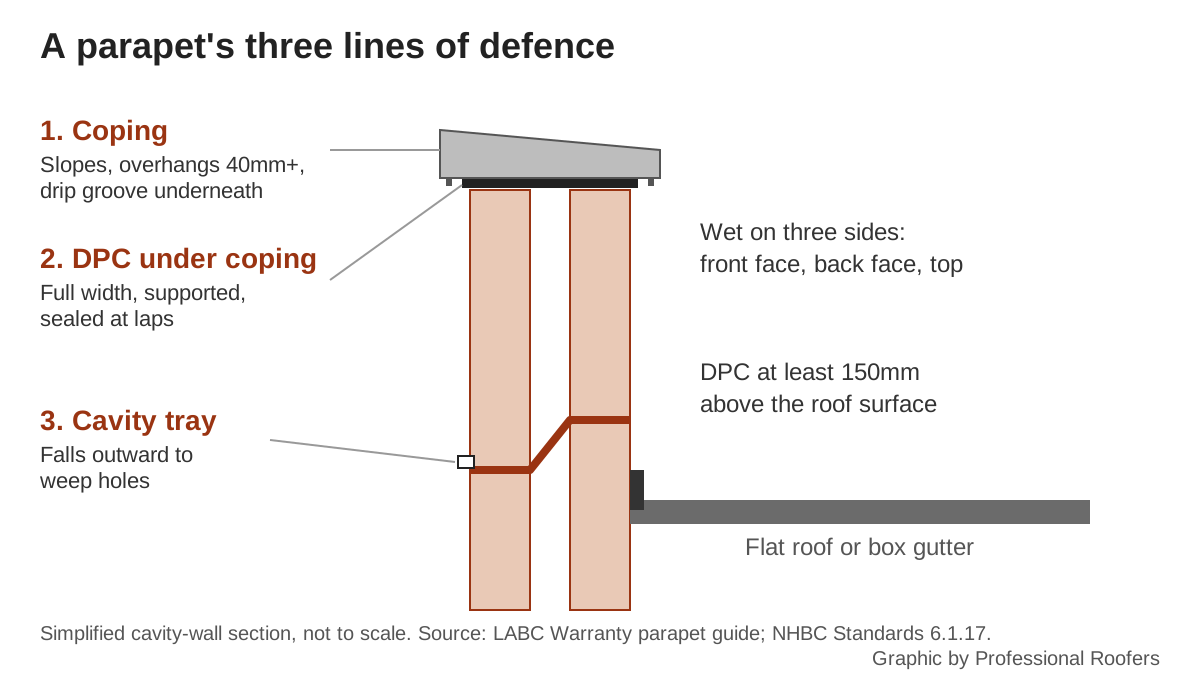
A parapet wall leaking into the room below is one of the hardest roof leaks to pin down, because a parapet is wet on three sides at once. It takes rain on its front face, on its back face where it rises above the roof, and on its top. The industry’s own warranty providers treat it as a high-risk detail for exactly that reason: LABC Warranty’s technical guide says the share of its claims for water getting in through failed coping details is “extremely high compared to other claims”.
Water gets into a parapet in one of four places: through the coping on top, past a missing or broken damp proof course (DPC) under the coping, through a failed cavity tray lower down, or from the gutter or flat roof behind it. Each one needs a different fix, and the cheap ones (a tube of mastic, a coat of sealant) almost never solve it. Here is how to work out which you have.
How a parapet is meant to keep water out
LABC Warranty describes a “three lines of defence” approach in its guide to creating weatherproof parapet walls:
- The coping. The cap on top of the wall. It should slope (at least two degrees, the guide says, and a coping with no fall is not permitted), overhang both faces by at least 40mm, and have a drip groove underneath so water falls clear rather than running back down the brickwork.
- The horizontal DPC directly under the coping, across the full width of the wall, fully supported where it crosses a cavity, with sealed laps.
- A cavity tray, in cavity-wall parapets, to catch any water that gets past the first two and send it out through weep holes on the outside face.
NHBC’s standards add the junction with the roof: the DPC and cavity tray guidance calls for a DPC under copings in parapets, and for the DPC to be taken up at least 150mm above the adjoining roof surface so it links with the roof upstand.
Older houses work differently. A Victorian or Edwardian terrace parapet is usually solid brick, with no cavity and no tray. It relies on the coping, a DPC if one was ever fitted, and a lead flashing where the roof meets the back of the wall. When any of those fails, water soaks straight down through the brickwork.
The four ways water gets in
1. Open joints in the coping
The most common and the most visible. Mortar between coping stones cracks and drops out with frost and movement, and rain runs straight into the wall. LABC lists “poor pointing between coping” as one of the principal failures it sees. On metal copings, the equivalent is failed joints and fixings punched through the top.
Signs: gaps you can see from the roof or a ladder; dark, damp brickwork in vertical stripes under particular joints; damp that appears after heavy rain from any direction.
2. No DPC, or a failed one, under the coping
If there is no DPC under the coping, or it is too narrow, torn or unsupported, water that gets through the coping joints soaks down into the wall. The same LABC guide names missing DPCs, DPCs “of insufficient width to cover across the whole parapet” and unsupported DPCs among the principal failures. On many older houses there simply never was one.
Signs: damp at the top of the internal wall below the parapet, or efflorescence (white salts) on the brickwork; damp that persists for days after rain stops.
3. A failed or missing cavity tray
In a cavity-wall parapet, the tray is the last line of defence. LABC’s investigations found trays with badly lapped joints, trays without weep holes, and in one case a tray set to fall the wrong way, towards the inner leaf, which sent water straight into the building.
Signs: no weep holes visible on the outer face just above roof level; water appearing at the ceiling line or high on an internal wall, especially on the side facing the prevailing weather.
4. The roof or gutter behind it
Many leaks blamed on a parapet come from behind it: a blocked or split box gutter, a flat roof upstand that is too low or has pulled away, or a lead flashing that has cracked or lost its mortar. The water then runs down the back of the wall or along the top of the ceiling and appears inside as if it came through the parapet.
Signs: the leak follows the line of a gutter; it is worse in prolonged rain than in wind-driven rain; it stops when the gutter is cleared. Our guide to a leaking box gutter covers the six faults that cause it.
How to tell which one from inside
| What you see inside | Most likely source |
|---|---|
| Damp patch along the ceiling where it meets the parapet wall, following the gutter line | Box gutter, roof upstand or flashing behind the parapet |
| Damp high on the wall under the parapet, worse after wind-driven rain | Coping joints or face of the parapet |
| Damp that spreads slowly down the wall and lingers for days | No DPC or a failed DPC under the coping |
| Water at ceiling level only during storms from one direction | Cavity tray fault, or no tray |
| Damp in one spot under a joint you can see is open | That coping joint |
Two checks help. First, note which weather produces the leak: steady vertical rain points to the gutter or roof behind; driving rain from one direction points to the wall itself. Second, if the box gutter is safely accessible, run a hose into it alone for a while, then over the coping separately. If only the gutter test produces water inside, you have your answer. Never go onto a roof yourself without proper access and edge protection.
The repairs, from quick patch to proper fix
Repointing the coping joints. Raking out and repointing failed joints is the cheapest repair, and the right first step where the joints are the only problem. It does not help if there is no DPC underneath, and on a parapet that has been repointed several times already, it is usually a sign the copings need lifting.
Lifting and rebedding the copings on a new DPC. The proper fix for most failed parapets. The copings come off, a new DPC goes on, supported across any cavity and lapped and sealed at joints, and the copings are rebedded and pointed in a durable mortar. Damaged or flat copings without a drip should be replaced with ones that slope and overhang.
Replacing a failed cavity tray. Involves taking down part of the parapet’s outer leaf to put in a correctly lapped tray with stop ends and weep holes. It is a bricklayer’s job with a roofer for the upstand.
Fixing the roof junction. Renewing the lead flashing, raising a flat roof upstand to the right height or relining a box gutter. See our page on lead flashing repair cost for what flashing work involves, and lead code numbers for which thickness should be used where.
What not to do. Painting the parapet with a clear sealer, or running mastic along every joint, rarely fixes a parapet leak and can trap water in the brick. LABC Warranty, for its part, does not accept reliance on site-applied sealants for the joints of metal copings.
Access and neighbours
Most parapet repairs need scaffolding, because the work is on the outer face and top of a wall that is often three or more storeys up. On a terrace, the parapet between two houses is usually a party wall, and works to it can involve your neighbour and the Party Wall etc. Act 1996. Our page on shared roofs on terraced houses explains who is responsible for what.
When to call someone
Call a roofer or builder if you can see open joints or loose copings, if the damp is getting worse, or if you have water reaching electrics or ceilings. A loose coping stone on a parapet is also a safety risk to anyone below. Ask the contractor which of the three lines of defence they think has failed and why, and be wary of anyone who offers to solve it with sealant alone.
Frequently asked questions
Why is my parapet wall leaking? Water is getting in through the coping joints, past a missing or failed DPC under the coping, through a faulty cavity tray, or from the gutter or flat roof behind. Parapets are exposed on both faces and the top, so they are a common source of leaks.
Can a parapet wall leak cause damp on the ceiling? Yes. Water that gets past the coping or tray often appears where the ceiling meets the wall. A box gutter or roof upstand behind the parapet causes the same pattern, so test the gutter separately.
Should there be a DPC under a coping? Yes. NHBC’s standards require a DPC beneath copings in parapets, and LABC Warranty’s guide lists a missing DPC as one of the main causes of failure. Many older houses were built without one.
How do you stop a parapet wall leaking? Repoint failed coping joints if the joints are the only fault. If there is no working DPC, the copings need lifting and rebedding on a new one. A failed cavity tray means partially rebuilding the outer leaf. Fix any gutter or flashing behind as well.
Will sealant stop a leaking parapet? Rarely for long. Mastic along joints and clear brick sealers tend to fail or trap water. Warranty providers do not accept site-applied sealants as the weatherproofing on metal copings.
Who is responsible for a parapet wall between two terraced houses? Usually it is a party wall shared by both owners. Check your deeds, and see our guide to shared roofs on terraced houses for how repairs and costs are normally handled.
Want costs like this each month?
Join the Roofline brief for current UK prices and quote-reading tips.
More from Professional Roofers
How Much Does a New Roof Cost in the UK in 2026?
What a new roof really costs in the UK in 2026, broken down by house size, material and the hidden extras, plus how to check you are being quoted fairly.
Chimney Repointing and Repair Cost UK (2026)
What chimney repointing cost is in the UK in 2026, why scaffolding drives the price, and how repointing compares to rebuilding, flashing and pot repairs.
Roof Inspection and Survey Cost UK: What's Checked and the Price
Roof inspection cost UK 2026: what a ground, ladder or drone survey checks, typical prices for each, and when a written roof report is worth paying for.