Underlay Sagging at the Eaves Gutter: The Eaves Tray Fix
By the Professional Roofers team
Updated 2026 · Independent cost guide
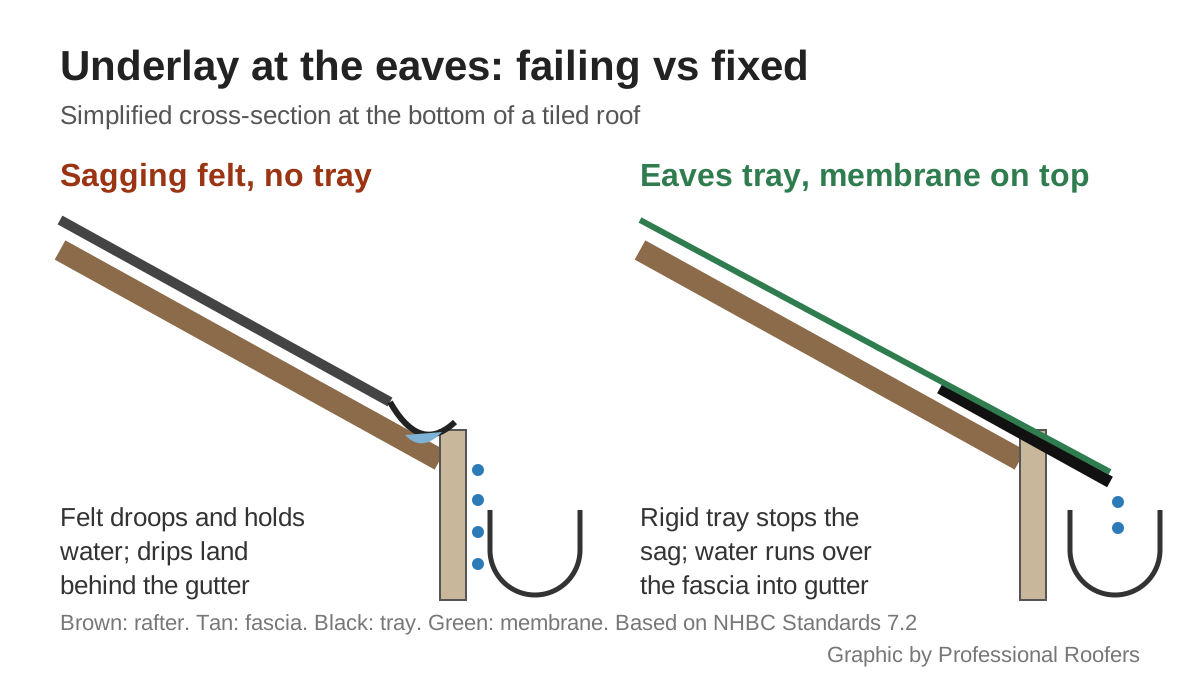
If water is dripping behind your gutter rather than into it, and the top of the fascia board is dark, soft or peeling, the likely culprit is underlay sagging at the eaves gutter, or underlay that has rotted away there altogether. It is one of the most common faults on UK pitched roofs from the felt era, and it has a giveaway: the damage is on the outside of the house, on the fascia and soffit, not on a bedroom ceiling. That is because the water is getting past the last line of defence at the very bottom of the roof, below the insulation and outside the walls.
The fix is small by roofing standards. It usually means lifting the bottom course or two of tiles and fitting a rigid eaves support tray with a new strip of UV-resistant underlay. This page explains what goes wrong, how to confirm it before you call anyone, and what a proper repair looks like.
What the underlay is supposed to do at the eaves
Under your tiles or slates there is a sheet of underlay: black bitumen felt on older roofs, a lighter plastic breathable membrane on newer ones. Its job is to catch any rain or snow that gets past the tiles and carry it down the roof. At the bottom, it has to deliver that water into the gutter.
For that to work, three things have to be true at the eaves:
- The underlay has to reach the gutter. NHBC Standards chapter 7.2 (pitched roofs) says underlay should “be dressed into the gutter where exposed at eaves level”.
- It has to survive being in daylight. The same clause says the exposed part must be UV resistant, or type 5U felt, or protected by “a proprietary eaves guard”.
- It must not sag. NHBC requires underlay at the eaves to “be supported by a continuous fillet or proprietary eaves support tray, laid to inclined falls… to prevent sagging (which can form a water trap)”.
An eaves support tray is simply a rigid strip, usually black PVC in 1.5m lengths, nailed to the rafters over the fascia. The underlay lies on top of it, so it cannot droop between the rafters, and the tray carries the water over the fascia and into the gutter. Klober, one of the main UK makers, describes its underlay support tray as preventing exposure of the membrane at the eaves “which leads to long-term degradation” and stopping ponding behind fascia boards.
The two ways it fails
It sags. On older roofs, felt was simply draped over the fascia between the rafters with nothing underneath it. Over decades it droops into a trough. The trough fills with water, moss, leaf litter and grit washed off the tiles. Water sits against the back of the fascia, and when the trough overflows, it runs down the back of the fascia board rather than into the gutter.
It rots away. Standard bitumen felt, type 1F, is not UV resistant. The strip that pokes out into the gutter gets full sun every day and becomes brittle, cracks and eventually breaks off. The felt then stops short of the gutter, and every drop that runs down it falls behind the gutter instead of into it.
Either way the result is the same: the fascia gets wet from behind, over and over, for years.
How to tell it is the underlay and not the gutter
Water behind a gutter has four common causes. From a ladder, on a dry day, you can usually tell which one you have.
| What you see | Most likely cause |
|---|---|
| Gutter full of silt and moss, water spills over the front edge | Blocked gutter; clear it first |
| Gutter sits well below or well out from the tile edge | Gutter brackets set wrong; tiles should project into the gutter |
| Felt visible under the bottom tiles is ragged, brittle, or ends short of the gutter | Perished underlay at eaves |
| Felt dips in a trough between rafters, holding debris or water | Sagging underlay, no support tray |
A useful reference point: NHBC also expects the bottom row of tiles to project at least 50mm across the gutter. If your gutter has been refitted lower or further out than the tiles, rain can miss it entirely in a wind, which looks very similar to an underlay fault.
To check the felt itself, look up under the bottom edge of the first course of tiles with a torch. On a healthy modern eaves you will see a black plastic tray with membrane sitting on it, running down into the gutter. On a failing one you will see torn black felt, or nothing but daylight and timber. Do not climb onto the roof, and if the eaves are above a first floor, use a roofer with proper access. Our guide to how often to inspect your roof covers what you can safely check from the ground.
What the repair involves
A proper eaves repair on a tiled roof usually goes like this:
- Access. A scaffold tower or a short run of scaffold along the affected elevation. Ladders alone do not give a safe working platform for lifting tiles.
- Strip the bottom courses. The roofer removes the eaves course and usually the next one up, carefully, so tiles can be reused.
- Cut back and replace the eaves felt. The rotten strip is cut away, the fascia is checked (and replaced if the top edge has rotted), and eaves support trays are nailed on over it, overlapping each other. Klober’s instructions call for 100mm overlaps.
- New underlay. A strip of UV-resistant membrane or 5U felt is laid over the tray and tucked under the existing underlay above, so water running down the old sheet flows onto the new one and not behind it. The new strip is dressed into the gutter.
- Re-lay and fix the tiles. Tiles go back on new battens where needed. Under the current BS 5534, perimeter tiles including the eaves course must be mechanically fixed, so expect nails and clips rather than the tiles just being hung back on. Our explainer on BS 5534 tile fixing sets out what applies.
- Check the gutter line. A good roofer will adjust the gutter brackets so the tiles project into it.
The most common botch is the underlay going under the tray instead of over it. Water then runs down the membrane, under the tray, and straight onto the fascia: the exact fault you were paying to fix. Ask to see a photo of the tray and membrane before the tiles go back on.
If the fascias are rotten along the whole run, it is often worth doing this at the same time as replacing them, since the same access and the same bottom courses are involved. Our page on fascia and soffit replacement costs covers that job.
When it points to a bigger problem
A perished strip at the eaves is often the first visible sign that the whole underlay is old 1F felt near the end of its life. If the roofer lifts the bottom courses and finds the felt above also brittle and torn, the underlay across the roof is not doing its job, and the conversation may shift to a re-roof. Our guide to roofing underlay and membranes explains the differences between old felt and modern breathable membranes, and why is my roof leaking covers faults further up the slope.
Frequently asked questions
Why is water dripping behind my gutter? Usually because the gutter is blocked, the gutter is set too low to catch water off the tiles, or the underlay at the eaves has sagged or rotted so it no longer reaches the gutter. The last one shows as a wet, stained or rotten top edge on the fascia board.
What is an eaves support tray? A rigid strip, usually black PVC, fixed to the rafters over the fascia board. It supports the roof underlay at the eaves so it cannot sag between rafters, and carries water over the fascia into the gutter. NHBC requires one, or a continuous fillet, on new-build pitched roofs.
Can an eaves tray be fitted to an existing roof? Yes. The roofer lifts the bottom course or two of tiles, cuts back the old felt, fits the trays and a new strip of UV-resistant underlay lapped under the existing sheet, then re-fixes the tiles. It does not need a full re-roof unless the underlay above is also failing.
Why has the felt at the bottom of my roof crumbled? Standard bitumen felt, type 1F, breaks down in sunlight. The strip that runs into the gutter is exposed every day and becomes brittle over the years. Modern practice is UV-resistant membrane, type 5U felt, or an eaves guard for that exposed section.
Is a sagging eaves underlay covered by home insurance? Rarely. Insurers treat it as wear and tear rather than a sudden event. Resulting storm damage may be a different matter; our page on home insurance and roof repairs explains where the line falls.
Should the membrane go over or under the eaves tray? Over. The underlay sits on top of the tray and runs into the gutter. If it goes under the tray, water runs behind it onto the fascia, which is the fault the tray is meant to cure.
Sources
NHBC Standards chapter 7.2, Pitched roofs (underlay and eaves detailing, tile projection into gutter); Klober underlay support tray product and fixing guidance; BS 5534 perimeter fixing requirements as summarised on our BS 5534 page. Checked 30 September 2026.
Want costs like this each month?
Join the Roofline brief for current UK prices and quote-reading tips.
More from Professional Roofers

How Much Does a New Roof Cost in the UK in 2026?
What a new roof really costs in the UK in 2026, broken down by house size, material and the hidden extras, plus how to check you are being quoted fairly.
Chimney Repointing and Repair Cost UK (2026)
What chimney repointing cost is in the UK in 2026, why scaffolding drives the price, and how repointing compares to rebuilding, flashing and pot repairs.
Roof Inspection and Survey Cost UK: What's Checked and the Price
Roof inspection cost UK 2026: what a ground, ladder or drone survey checks, typical prices for each, and when a written roof report is worth paying for.