Downpipe Leaking at the Joint? Check Below It First
By the Professional Roofers team
Updated 2026 · Independent cost guide
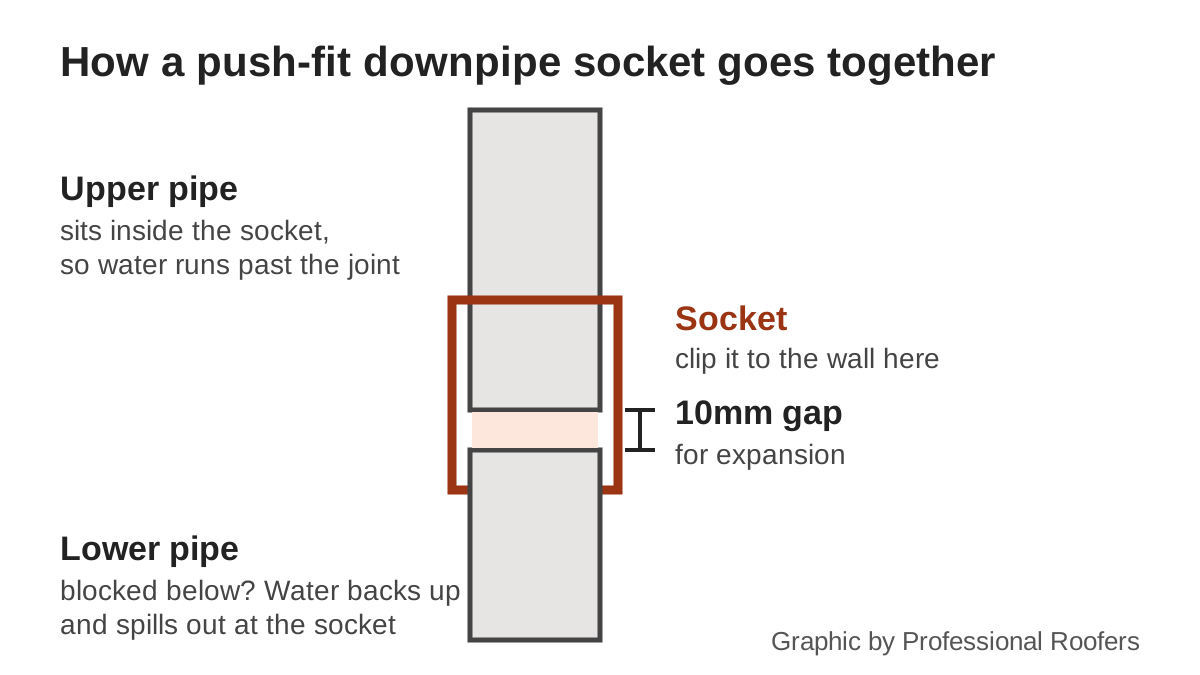
A downpipe leaking at the joint is usually a sign of a problem lower down the pipe, not a faulty joint. A downpipe is meant to carry water falling past each joint, not to hold standing water. If a blockage below stops it draining, the pipe fills and the water spills out at the first socket it reaches. So sealing that socket with silicone can leave the blockage in place and push the leak somewhere else.
Here is how to find which fault you have, working from the most common cause to the least.
Test it first: leak or back-up?
On a dry day, run a hose into the gutter at the high end, or pour a bucket of water into the gutter outlet if you can reach it safely from the ground or a properly footed ladder. Then watch the pipe.
| What you see | Likely cause |
|---|---|
| Water spills from a socket and gets worse as you keep pouring | Blockage below that joint |
| Water spills only at the top, near the gutter | Blocked offset or swan neck, or a loose outlet |
| A steady drip from a joint, no matter how little water goes in | A loose, misaligned or cracked joint |
| Water runs out at ground level around the base of the pipe | Blocked shoe or gully |
| Damp patch on the wall behind, with no visible drip | Split at the back of the pipe, or a joint leaking against the wall |
Do not work from a ladder in wind or on wet, sloping ground. For anything above the first floor, call a roofer or gutter firm with a pole system or a safe means of access.
1. A blockage below the joint
Leaves, moss, roof granules and even bird nests collect wherever the pipe changes direction, and at the bottom. Start at the bottom, as that is the easiest place to reach.
Clear the gully, then take off the shoe if there is one, then rod upwards. If the water drains and the leak stops, you have fixed it. In a hard frost, a pipe holding water can also freeze and split, so clear a slow-draining pipe before winter rather than after.
If the gutter overflows in heavy rain as well, it is likely to be the same blockage. Our gutter cleaning cost page sets out what a firm charges to clear both.
2. A blocked offset or swan neck
The offset is the S-shaped bend under the eaves, where the downpipe comes back to the wall from the gutter outlet. It is the tightest route in the system and a common place for a leaf plug. Water backs up behind it and escapes at the outlet or the first joint.
Most plastic offsets pull apart for cleaning once you loosen the top clip. Lift out the debris, flush the bend, and put it back in the same order. A leaf guard over the outlet helps if trees overhang the roof, but it needs clearing too.
3. A joint that has moved
On plastic systems, the pipe push-fits into a socket. FloPlast’s fitting note for its 68mm round downpipe socket says to leave a 10mm gap between the end of the pipe and the bottom of the socket for expansion, and to fix a pipe clip over the joint. Check for these faults:
- A pipe pulled out of its socket. A failed or missing clip lets the upper pipe drop or lean. Refit the pipe into the socket and add a clip at the joint.
- A pipe pushed hard against the socket base. With no gap, it has no room to expand, and it can bow and pull other joints out of line. Lift it out, trim the end if needed, and refit it.
- A socket fitted upside down. The upper pipe should sit inside the socket, so that water falls past the joint. If the pipe below sits over the pipe above, water can run out at the join. Refit it the right way round.
- Mixed systems. A round pipe from one maker may not sit properly in another’s socket. Most plastic systems are made to BS EN 12200, but check the manufacturer’s compatibility guide, and replace the mismatched section.
Silicone is not the fix for any of these. Sealing a plastic joint stops it moving, so it can split when the pipe expands and contracts, as with a gutter joint.
4. Cracked pipe or socket
Plastic turns brittle after years of sun, and impact from a ladder or a bin can crack it. A cracked plastic length or socket is cheap to replace, and a like-for-like section is usually easy to find.
Cast iron fails differently. It rusts from the back, where you cannot paint it against the wall, so check behind the pipe with a mirror. The fixing ears can also snap, letting a length drop out of line. Short-term repair products can buy you time, but a split length needs replacing, and a good firm can usually supply matching cast-iron or cast-effect sections. Old paint on cast iron may contain lead, so do not dry-sand it. Our guttering replacement cost page compares the materials.
5. Older grey pipes: check for asbestos
On older houses and garages, a stiff grey downpipe may be asbestos cement rather than plastic. Do not drill, cut or break it. Get it identified first, and read the HSE’s asbestos guidance.
When a wet wall matters more than the leak
A downpipe leaking against a wall for months can soak the brickwork and show up as damp indoors, sometimes well away from the joint. If you see green staining behind the pipe, blown render or damp inside, fix the leak first and give the wall time to dry out before you redecorate. If you have a stain indoors and no obvious leak at the pipe, read why your roof might be leaking, as the source may be higher up.
DIY or call someone?
A ground-floor joint, a shoe or a gully is a reasonable DIY job. Call a professional if the joint is at height, the pipe is cast iron and has dropped, you think it may be asbestos, or the leak returns after rodding, as the blockage may be in the underground drain rather than the downpipe.
Frequently asked questions
Why is my downpipe leaking at the joint only when it rains heavily? It usually means a partial blockage below the joint. In light rain, the pipe can keep up. In a downpour, it fills and spills out at the nearest socket. Clear the gully and rod the pipe from the bottom.
Should I seal a leaking downpipe joint with silicone? No, not as a first fix. Silicone leaves any blockage in place, and on plastic pipe it stops the joint moving as the pipe expands. Find the cause and refit the joint.
How much gap should a downpipe joint have? FloPlast’s fitting note for its 68mm round downpipe socket says to leave 10mm between the end of the pipe and the bottom of the socket. Check the instructions for your own system.
Which way round does a downpipe socket go? The upper pipe should sit inside the socket, so that water falls past the joint and does not run out through it.
Can a leaking downpipe cause damp? Yes. A joint leaking against a wall for months can soak the masonry, and it can show up as damp inside. Fix the leak first, then let the wall dry out before you redecorate.
How do I unblock a downpipe without a ladder? Start from the bottom. Clear the gully, remove the shoe if there is one, and use drain rods up the pipe. If the blockage is in the offset under the eaves, a gutter firm with a pole system can reach it from the ground.
Want costs like this each month?
Join the Roofline brief for current UK prices and quote-reading tips.
More from Professional Roofers

How Much Does a New Roof Cost in the UK in 2026?
What a new roof really costs in the UK in 2026, broken down by house size, material and the hidden extras, plus how to check you are being quoted fairly.
Chimney Repointing and Repair Cost UK (2026)
What chimney repointing cost is in the UK in 2026, why scaffolding drives the price, and how repointing compares to rebuilding, flashing and pot repairs.
Roof Inspection and Survey Cost UK: What's Checked and the Price
Roof inspection cost UK 2026: what a ground, ladder or drone survey checks, typical prices for each, and when a written roof report is worth paying for.