Spray Foam Insulation Mortgage: 8 Lenders Now Say Yes
By the Professional Roofers team
Updated 2026 · Independent cost guide
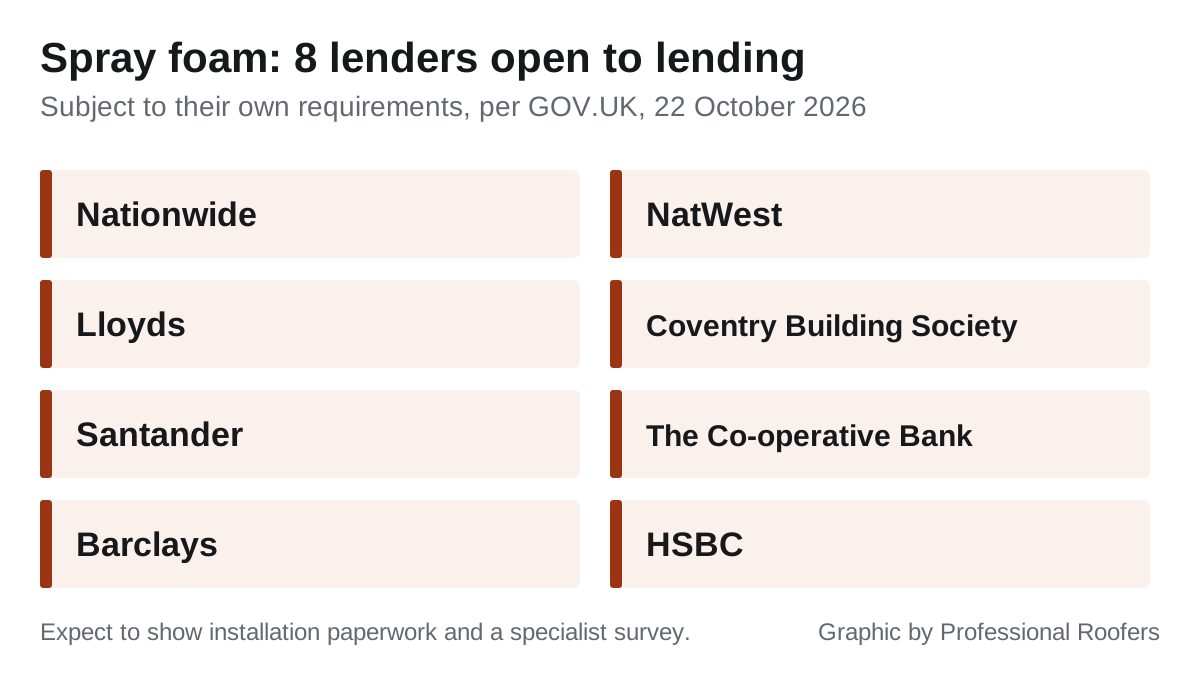
If a buyer’s valuation has come back flagging spray foam in the loft, or you are remortgaging and worried it will, the spray foam insulation mortgage problem is less fixed than it was. On 22 October 2026 the government published guidance listing eight mortgage lenders that are open to lending on homes with spray foam, subject to their own requirements. Removal is not the automatic answer, and the government’s own advice is that it will not always guarantee a lender says yes.
This page explains why surveyors and lenders flag spray foam, what the inspection actually looks for, the paperwork that turns a “no” into a “maybe”, and when removing the foam makes sense.
The eight lenders on the government’s list
The Department for Energy Security and Net Zero’s paper, Spray foam insulation: remediation, removal and lending, names these lenders as open to lending on properties with spray foam, subject to their own requirements:
- Nationwide
- Lloyds
- Santander
- Barclays
- NatWest
- Coventry Building Society
- The Co-operative Bank
- HSBC
“Subject to their own requirements” is doing a lot of work. In practice it usually means the valuer asks for the installation paperwork, a specialist survey, or both, and each case is judged on that evidence. The Co-operative Bank is worth noting: it was among the lenders a BBC investigation reported as refusing spray foam outright. The list is not closed, and lenders can ask to be added or report a change.
Equity release is the hard case. The joint industry consumer guide notes that the HomeOwners Alliance found no equity release lenders willing to lend on a home where spray foam was added after it was built.
Why lenders and surveyors flag spray foam
Spray foam is a liquid insulation sprayed onto the underside of the roof, where it expands and sets into a solid layer. It has been widely sold, sometimes through cold calling and sometimes under government schemes, as a quick way to insulate a loft and “stabilise” old tiles. Lenders worry about it for reasons that come down to one thing: nobody can see the roof any more.
- The timbers are hidden. The foam covers rafters, battens and the back of the tiles in a single layer. A surveyor cannot check for rot, cracks or woodworm, and a slow roof leak behind the foam may never show.
- Moisture can get trapped. Closed-cell foam sprayed straight onto the tiles, with no underlay behind it, is the worst combination. Water vapour from the house meets the cold underside of the foam and the timber it encases, and condensation can rot the battens and rafters out of sight.
- Ventilation is lost. Sealing every gap also stops the roof space breathing. A roof that relied on airflow at the eaves and ridge to carry moisture away can start to suffer from damp and mould. Our roof ventilation guide explains how a pitched roof is meant to breathe.
- Repairs get harder. A tile glued to its neighbours with foam often cannot be lifted and reused. A small repair can turn into stripping a whole section.
None of this means every installation is faulty. Open-cell foam applied over a breathable underlay, in a ventilated roof, with the right paperwork, can be judged low risk. The problem for a lender is that without evidence, the surveyor cannot tell which kind you have.
Open-cell vs closed-cell foam
| Open-cell | Closed-cell | |
|---|---|---|
| Feels | Soft, spongy, can be dented with a thumb | Hard and rigid |
| Lets vapour through | Yes, it is vapour permeable | Largely no, it acts as a vapour barrier |
| Usual purpose | Insulation | Often sold to “stabilise” tiles, plus insulation |
| Main risk | Moisture passing through and condensing on a cold, non-breathable layer behind | Trapping moisture against timber and tiles |
The industry inspection protocol asks the surveyor to record which type it is, and whether it is sprayed onto an underlay, sarking boards or spacer cards, or directly onto the tiles or slates. If they cannot tell, they are supposed to say so rather than guess.
What the specialist inspection looks for
Lenders and the government point to the Spray Foam Insulation Inspection Protocol (March 2023), written for surveyors by the Property Care Association and the Residential Property Surveyors Association. A surveyor following it will record:
- the roof’s construction and the condition of the tiles, underlay and gutters
- signs of trouble below: staining, salt deposits, mould, fungal decay, woodworm
- the moisture content of the roof timbers, with north-facing and shaded slopes, wall plates, valleys and purlin ends checked first
- whether the foam is open or closed cell, and what it is stuck to
- whether the loft is a ventilated cold roof or an unventilated warm roof, and whether there is a vapour control layer at ceiling level
- things that push moisture into the loft: extractor fans venting into it, downlighters, open water tanks
Timber moisture readings change with the season, so a reading taken in winter can look worse than one taken in August. The surveyor compares readings with any taken before installation, which is one reason the original handover pack matters so much.
A standard mortgage valuation is not this survey. If the valuer flags spray foam, the lender will usually want a separate specialist report. You can find surveyors who work to the protocol through the Property Care Association’s find a specialist tool. Our page on roof inspections and surveys explains the different levels of survey.
The paperwork that clears it
The joint consumer guide from the Insulation Manufacturers Association, Property Care Association and Residential Property Surveyors Association says a complete handover pack should include:
- a pre-installation evaluation of the roof
- a hygrothermal evaluation (a condensation risk assessment for your roof)
- the product’s third-party certificate, from the BBA or KIWA
- the installer’s details, credentials and any guarantees or warranties
If you have all four and a competent surveyor confirms the work matches them, the installation is likely to be treated as low risk with no further action. If you do not have them, ask the installer or the foam manufacturer: the government guidance says they should be able to provide the paperwork retrospectively.
When removal makes sense, and what it involves
A specialist surveyor may conclude the foam is fine, recommend remedial work, recommend removing it, or say the roof needs recovering. Removal is most likely to be advised where closed-cell foam is sprayed directly onto tiles or slates with no underlay, where timbers show high moisture or decay, or where the foam was over-sprayed onto wall plates and eaves and blocked the ventilation.
Removal means cutting and scraping the foam off the rafters, battens and tile backs by hand, bagging it and carting it away, then checking every timber now exposed. Where foam was glued straight to the tiles, the tiles often break or cannot be refixed, so removal turns into stripping and re-roofing, with a new breathable membrane, battens and the old or new tiles. That is a much bigger job than the removal quote suggests. Get at least two quotes, and make sure one comes from a roofer rather than only a foam removal firm. Our walkthrough of the roof replacement process, step by step covers what a full strip and re-roof involves.
The government guidance makes two warnings worth repeating. Talk to your lender before removing anything, because removal does not guarantee they will then lend. And badly done removal can cause new damage.
Cold callers and removal firms
The growth of the removal industry has brought cold calls and pressure selling. The government says unsolicited offers can be reported to trading standards, and if you think your original installer passed your details to a removal company, you can complain to the Information Commissioner’s Office. The consumer guide’s advice is blunt: do not be rushed, do not pay everything upfront, and get comparable quotes.
If the installer did a bad job
If the foam went in under a government scheme since 2020, the installer must have been TrustMark registered. For work less than six years old, with the installer still trading, use TrustMark’s dispute resolution process, then the Dispute Resolution Ombudsman. If the installer has gone, contact the insurance-backed guarantee provider named in your paperwork; these typically run up to 10 years. If you paid by credit card, the consumer guide suggests you may be able to ask your card provider for a refund.
Frequently asked questions
Can I get a mortgage on a house with spray foam insulation? Often yes. The government’s October 2026 guidance lists Nationwide, Lloyds, Santander, Barclays, NatWest, Coventry Building Society, The Co-operative Bank and HSBC as open to lending, subject to their own requirements. Expect to provide the installation paperwork and possibly a specialist survey.
Do I have to remove spray foam to sell my house? Not necessarily. Take advice from a specialist surveyor first; only someone experienced in spray foam can say whether it should come out. Removal does not guarantee a lender will accept the property, so speak to the buyer’s lender before doing anything.
Which spray foam is worse for a mortgage, open-cell or closed-cell? Closed-cell foam sprayed straight onto tiles with no underlay is the combination surveyors worry about most, because it can trap moisture against the timbers. Open-cell foam over a breathable underlay in a ventilated roof is more often judged low risk, but the evidence still matters.
What documents do I need for spray foam insulation? A pre-installation roof evaluation, a hygrothermal (condensation risk) evaluation, the BBA or KIWA product certificate, and the installer’s details with any guarantee. If you are missing them, ask the installer or manufacturer for copies.
Who can inspect spray foam insulation? A specialist surveyor who works to the Spray Foam Insulation Inspection Protocol of March 2023. The Property Care Association’s find a specialist tool lists them, and RICS, RPSA and CABE members may also offer it.
Can I get equity release with spray foam insulation? It is very difficult. The industry consumer guide cites the HomeOwners Alliance finding that no equity release lenders would lend on a home where spray foam was added after it was built.
Want costs like this each month?
Join the Roofline brief for current UK prices and quote-reading tips.
More from Professional Roofers
How Much Does a New Roof Cost in the UK in 2026?
What a new roof really costs in the UK in 2026, broken down by house size, material and the hidden extras, plus how to check you are being quoted fairly.

Chimney Repointing and Repair Cost UK (2026)
What chimney repointing cost is in the UK in 2026, why scaffolding drives the price, and how repointing compares to rebuilding, flashing and pot repairs.
Roof Inspection and Survey Cost UK: What's Checked and the Price
Roof inspection cost UK 2026: what a ground, ladder or drone survey checks, typical prices for each, and when a written roof report is worth paying for.