Sarking Boards on Scottish Roofs: Rot Signs and Repairs
By the Professional Roofers team
Updated 2026 · Independent cost guide
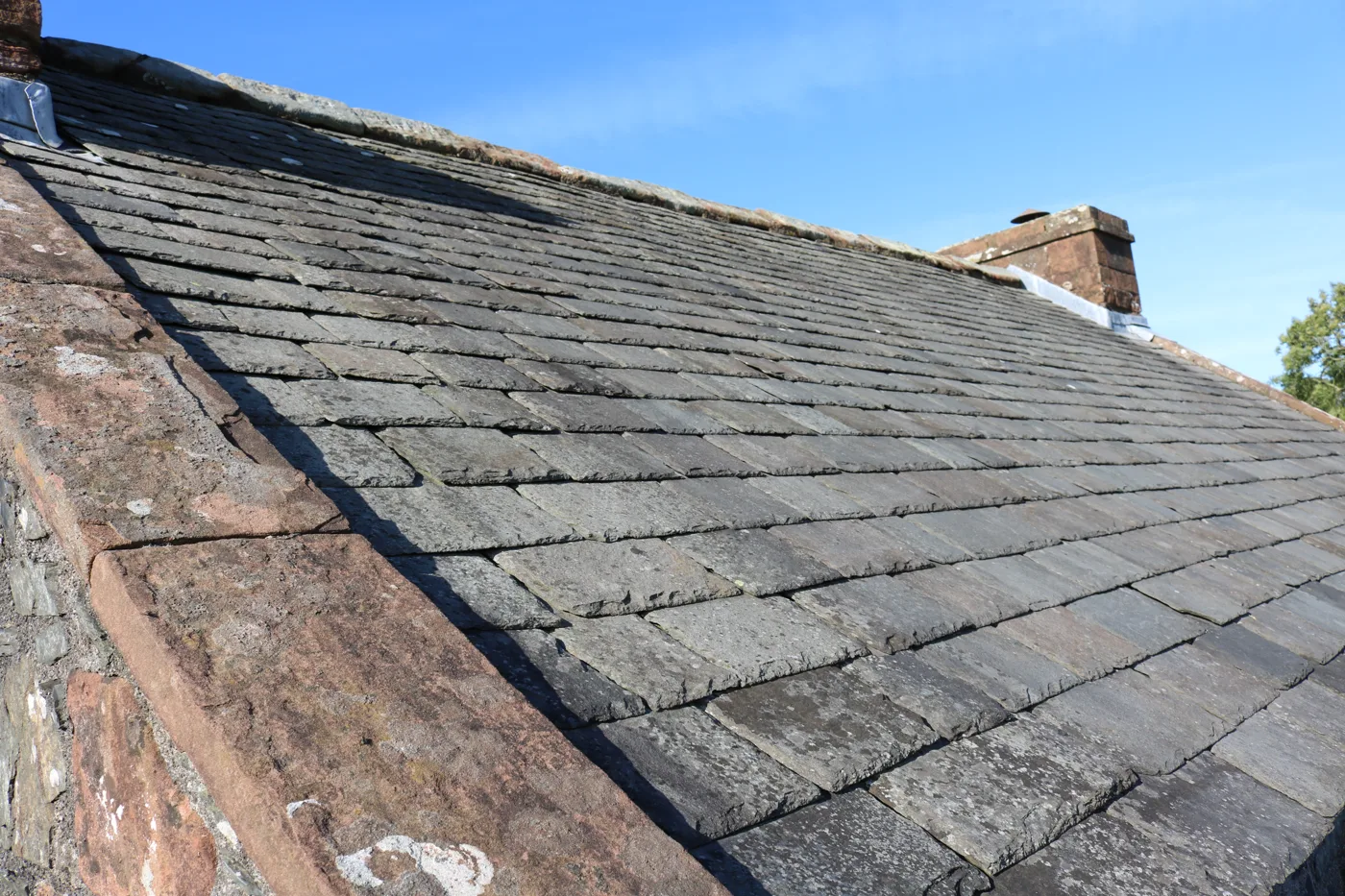
Sarking boards are the continuous layer of timber boards nailed across the rafters of most Scottish pitched roofs, with the slates nailed straight onto them. In England and Wales slates and tiles usually hang on thin battens over a membrane, with nothing solid underneath. In Scotland the boards are the deck, and they matter as much as the slates: they hold every nail, brace the roof against wind, and decide whether a re-slating job is a straightforward swap or a much bigger one.
This page explains how sarking works, why it fails, what you can check from the loft, and the questions that sort a fair quote from one padded with work the roof does not need.
Sarking in Scotland is not sarking in England
The word causes confusion across the border. In England, “sarking” or “sarking felt” often means the underlay sheet laid over the rafters under tiles. In Scotland it means the timber boards themselves. If you are reading an English website, a forum thread or a product page, check which one it means before you act on the advice.
How a traditional Scottish slate roof is built
Historic Environment Scotland’s guidance on repairing Scottish slate roofs, written by its conservation specialist Moses Jenkins, sets out the traditional build:
- Boards, not battens. Scottish slate roofs are almost always laid onto sarking boards rather than battens.
- A “penny gap” between boards. Boards were laid with a gap of about the thickness of an old penny. It let the timber expand and shrink, ventilated the roof space, and let any wind-driven rain that got under the slates drain and dry out.
- One nail per slate. Each slate is fixed with a single nail through the centre of its head, straight into the sarking. Slates were shaped “squared and shouldered” so a roofer could slide neighbours aside to reach a broken one.
- Diminishing courses. Random-sized Scottish slates were laid largest at the eaves, smallest at the ridge, which gives these roofs their distinctive look.
The single nail is why sarking condition matters so much. On a battened roof a slate is usually held by two nails into a batten; on a Scottish roof the whole slate hangs on one nail in one board.
Why sarking boards fail
Water getting in at a missing or slipped slate
The commonest cause. HES warns that if a missing slate is not replaced, the sarking beneath it will decay. One gap in the slating lets rain sit on the same patch of board every time it rains, and a board that stays wet for a winter or two will soften. Replace a missing slate as soon as you see it; it is one of the cheapest roof repairs there is.
Nail sickness
Old iron nails rust away, slates slip, and the nail holes in the boards rust and widen. A board riddled with corroded nail holes no longer gives a new nail anything solid to bite into. That is why a good re-slating job clears the boards of old nails before anything new goes on. Our page on nail sickness explains how to recognise the slipped-slate pattern from the ground.
Leaks at flashings, valleys and skews
Loose lead at a chimney, a split valley or a failed skew (the coping on a gable parapet) puts water into the boards next to it. These are the places rot is most often found, because water runs there from a wide area of roof.
Condensation and lost ventilation
The penny gap only works if air can move. Where boards have been covered with an impermeable bitumen felt, or the loft has been insulated without keeping the eaves clear, moisture from the house can condense on the underside of the boards. HES warns that bituminous under-slate felts and other barriers that stop water vapour moving can raise humidity in the roof space and harm the roof over time. Our loft condensation page covers how to tell condensation from a leak.
What you can check yourself
You can tell a lot from inside the loft with a torch, without going on the roof:
- Dark staining on the underside of boards, especially in lines running down the slope from one point. That usually marks a leak at a slate or flashing above.
- Soft timber. Press a screwdriver gently into a stained area. Sound timber resists; rotten timber lets the tip sink in.
- Daylight through a board or between boards wider than the original small gap.
- Rusty nail tips poking through, or rust streaks running down from them.
- White fungal growth or a musty smell, which means timber has been wet for a long time. Call a roofer or surveyor promptly.
- The eaves and wall head. Look where the rafters meet the wall. Water that gets past the slates often ends up at the rafter ends and wall plate, so a careful roofer lifts the lowest boards during repairs to check them.
Do not walk on a slate roof to look. Slates crack underfoot and a roof survey from a scaffold or roof ladder costs far less than the damage. Our roof inspection and survey page explains what a proper survey should cover.
Repair options, from small to large
Patch repair: a few slates and the boards under them
If the rot is local, a roofer strips the slates over the area, cuts out the damaged board lengths, fits new boards with a small ventilation gap, and re-slates the patch. The rest of the roof is untouched. This is the right answer for a single leak that has been caught within a season or two.
Re-slating on the existing sarking
HES’s guidance is clear that sound sarking boards can stay: in many cases the existing boards are in good enough condition for new slates to be nailed onto them, with a breathable membrane added over the top. A good roofer will strip the slates, inspect every board, replace only the boards that are soft or split, pull or punch old nails, lay a vapour-permeable membrane and re-slate. This keeps the original deck and avoids paying for timber the roof does not need.
Re-slating with full new sarking
Only justified if a large part of the deck is rotten or weakened by nail holes, or if the rafters need work that means stripping the boards anyway. New boards should be laid with a small gap for ventilation, as the originals were. Ask for a sample of the old boards to be kept so you can see the condition for yourself.
When the whole roof needs doing
HES’s rule of thumb is that if more than 25 per cent of the slates on a roof are loose or defective, re-slating will be needed rather than repairs. That rule is about the slates, not the boards. A roof can need re-slating while its sarking is perfectly sound.
What it costs, and how to read the quote
There is no standard published rate for sarking repairs; roofers price it by the length of board or by the square metre once the slates are off, and nobody can know the real quantity until then. Our slate roofing guide gives typical installed prices for a slate re-roof. What you can control is how the quote is written:
- Ask for sarking as a separate line, priced per board length or per square metre, with an allowance stated as a quantity (for example “up to 10 square metres”), not a lump sum.
- Ask how extra boards will be agreed. The standard approach is a stated rate for extra boards, with photographs before they are fitted.
- Ask which membrane goes over the boards. It should be a vapour-permeable type. HES warns against bituminous felt that traps moisture.
- Ask about the slates. No Scottish slate has been produced for over 50 years, so most jobs use reclaimed Scottish slate or new imported slate matched for size and colour. Ask which, and whether the diminishing courses will be kept. If the building is listed or in a conservation area, your council may require a match.
- Be wary of “all new sarking” on sight from the ground. Nobody can see board condition without lifting slates or going into the loft.
Frequently asked questions
What are sarking boards? Sarking boards are timber boards nailed edge to edge across the rafters of a pitched roof, forming a solid deck that the slates are nailed to. They are standard on traditional Scottish slate roofs, where they replace the battens used in most of England and Wales.
Do sarking boards need replacing when a roof is re-slated? Not always. Historic Environment Scotland’s guidance says sound boards can stay, with new slates fixed onto them over a breathable membrane. Only soft, split or badly nail-damaged boards need replacing.
Why do sarking boards have gaps between them? Traditionally boards were laid with a “penny gap”, about the thickness of an old penny. It allows the timber to move with the seasons and lets air through to keep the roof space and boards dry.
Should felt go over sarking boards? If anything goes over the boards it should be a vapour-permeable membrane. Bituminous felt and other barriers that stop water vapour moving can trap moisture and raise humidity in the roof space, which shortens the life of the timber.
How do I know if my sarking is rotten? From the loft, look for dark staining, timber a screwdriver sinks into, daylight through boards, rusty nail tips and fungal growth or a musty smell. The worst rot is usually under a missing slate, at flashings and valleys, and at the eaves.
Is sarking the same as roofing felt? In England the word is often used for the underlay sheet. In Scotland sarking means the timber boards. Check which is meant before following advice or comparing quotes.
Want costs like this each month?
Join the Roofline brief for current UK prices and quote-reading tips.
More from Professional Roofers
How Much Does a New Roof Cost in the UK in 2026?
What a new roof really costs in the UK in 2026, broken down by house size, material and the hidden extras, plus how to check you are being quoted fairly.
Chimney Repointing and Repair Cost UK (2026)
What chimney repointing cost is in the UK in 2026, why scaffolding drives the price, and how repointing compares to rebuilding, flashing and pot repairs.
Roof Inspection and Survey Cost UK: What's Checked and the Price
Roof inspection cost UK 2026: what a ground, ladder or drone survey checks, typical prices for each, and when a written roof report is worth paying for.