Finlock Gutters: Why They Leak, and Reline or Remove?
By the Professional Roofers team
Updated 2026 · Independent cost guide
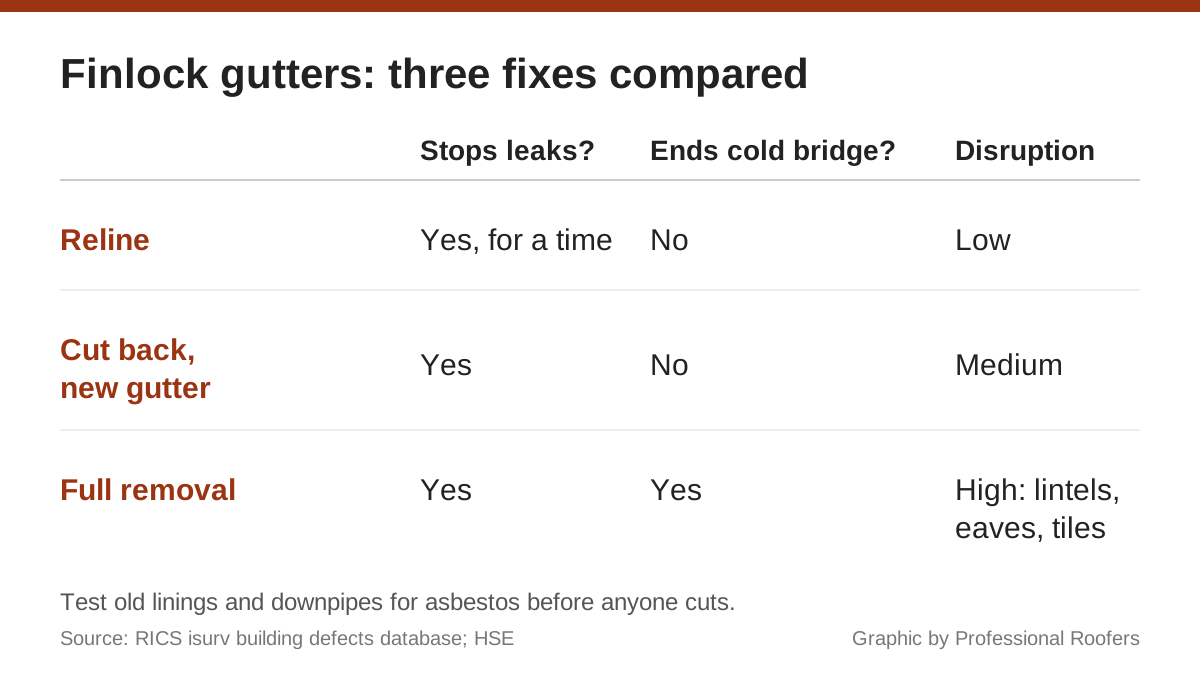
Finlock gutters are the chunky concrete gutters built into the top of the walls on many houses from the 1950s to the 1970s, a lot of them council-built. They were meant to need no maintenance. Seventy years on, most leak at the joints between the concrete sections, and the water and the cold concrete together cause the damp patches and grey mould lines that owners notice along the top of bedroom walls. The fix is not always full removal. A surveyor writing in the RICS building defects database says the need for removal “should not automatically be assumed”, and a sound gutter with a good lining can last for years yet. This page explains how to tell which you have.
What a Finlock gutter is
A Finlock gutter is a run of precast concrete sections laid end to end on top of the outer wall at the eaves. Each section is a U-shaped trough. The front part forms the gutter you see from the street; the back part sits over the wall and, on many houses, the trough behind it was filled with concrete to make the lintel over the first-floor windows. So the gutter is not hung on the house like a plastic one. It is part of the top of the wall.
That design has three consequences:
- Joints. The sections meet end to end, and each joint was sealed with mortar or mastic that has long since cracked. Water sitting in the gutter finds the joint and runs into the wall.
- Cold bridging. The concrete runs from the outside air straight across the top of the cavity to the inner wall. In winter the inside face of the wall at ceiling height is colder than the rest of the room, warm moist air condenses on it, and you get a strip of black mould or a grey band along the top of the wall, often on every outside wall of the house. This is condensation, not a leak, and relining will not cure it.
- Lintels. Where the gutter trough doubles as the lintel over the windows, water leaking through the joints can damage the concrete and any steel inside it, and removing the gutter means dealing with the lintel too.
Signs your Finlock gutter is failing
| What you see | Most likely cause |
|---|---|
| Damp patch or stain on the bedroom ceiling or wall, worse after rain | Leaking joint or failed lining |
| Black mould or a grey line along the top of outside walls, worse in winter, not linked to rain | Cold bridging and condensation |
| Water dripping or staining down the outside face of the wall below a joint | Leaking joint |
| A dip or uneven line along the gutter from the street | Sections that have moved; check the joints closely |
| Cracked, spalling concrete with rust stains | Corroding reinforcement; needs a closer look |
| Water standing in the gutter long after rain | Blocked outlet or sections that have lost their fall |
A slight dip on its own is not necessarily serious. The RICS defects database shows a 1950s house with a visibly uneven Finlock gutter that it describes as “a minor defect without structural significance”. What matters is whether water is getting through.
Option 1: Clean, repair the joints and reline
Most Finlock gutters have been lined at least once. Linings used over the years include felt and bitumen, stainless steel profile sections, fibreglass (GRP) and liquid coatings, and modern EPDM rubber membranes. A lining covers the joints so that water runs over them instead of into them.
When it makes sense: the concrete is sound, there is no cracking or rusting reinforcement, the gutter still has a fall to its outlets, and the damp problem is a leak rather than condensation.
What a good job includes: clearing out debris and old failed lining, checking and repairing each joint, a continuous lining dressed up under the bottom row of tiles so water cannot get behind it, and properly sealed outlets. Ask what the lining is, how it is joined, and what guarantee comes with it.
Its limits: a lining stops leaks but does nothing about cold bridging, and every lining eventually fails. The RICS example shows a stainless-steel lining that “now needs to be replaced”. Expect to reline again in the life of the house.
Option 2: Cut back and fit a new gutter
Some roofers cut off the front part of each concrete section, cap the remaining concrete, fit a timber fascia, and hang a new uPVC or aluminium gutter on it. The back part of the section stays in the wall.
When it makes sense: the concrete is sound and you want to get rid of the open concrete trough, but you do not want the cost and disruption of full removal.
Its limits: the concrete still crosses the cavity, so cold bridging stays. Make sure the capping is watertight and that cutting the front off does not weaken a section that is acting as a lintel. Ask the contractor how they will check that.
Option 3: Full removal and conventional eaves
The concrete sections come out completely. The top of the wall is rebuilt, new lintels are fitted over the windows where the gutter was acting as one, the rafters are extended to form a normal overhanging eaves, and a fascia, soffit and new gutter go on. Done well, it ends both the leaks and the cold bridging, because the cavity is no longer bridged at the top.
When it makes sense: the concrete is cracked or has rusting reinforcement, the lintels are damaged, or the house has persistent condensation along the top of the walls that keeps coming back.
Its limits: it is the most expensive option by a distance, and it is building work, not just roofing: scaffolding, the bottom courses of roof tiles stripped and relaid, brickwork, lintels and new eaves timbers. Because it affects lintels and possibly the roof structure, ask whether it needs Building Regulations approval, and who will notify building control. Our pages on guttering replacement costs and fascia and soffit replacement costs cover the parts of the job that follow the removal.
Asbestos: test before anyone cuts
Finlock gutters themselves are concrete, but asbestos turns up in old linings, mastics and the cement downpipes often fitted with them. The HSE says asbestos can be found in any home built or refurbished before 2000, and lists asbestos cement gutters and downpipes among the places to look. Before any cutting, grinding or removal, ask the contractor whether they will have suspect material sampled, and do not let anyone power-cut an old lining or downpipe without knowing what it is. Our page on asbestos garage roof removal explains how testing and licensed removal work.
Which option to choose
- Diagnose first. Work out whether your damp is a leak (follows rain) or condensation (follows cold weather, appears on all outside walls). If it is mostly condensation, relining alone will disappoint you.
- Get the concrete looked at. A roof inspection or survey from scaffold or a cherry picker shows whether sections are cracked, rusting or moving. Ask for photographs.
- Sound concrete, leaking joints: reline, and keep the gutter clear.
- Sound concrete, but you want rid of the trough: cut back and fit a new gutter, accepting the cold bridge.
- Damaged concrete, damaged lintels or persistent condensation: full removal.
- Get at least three quotes that spell out which option each contractor is pricing, because one firm’s “Finlock replacement” can be another’s cut-back.
If you share a terrace or a semi, check what your neighbours have done. The RICS photographs show a terrace where the end and middle houses kept their Finlock gutters while their neighbours replaced theirs, and where the gutter runs continuously across the party wall, the junction needs careful detailing so water does not run from their gutter into your wall.
Frequently asked questions
What are Finlock gutters? Precast concrete gutter sections built into the top of the outer wall at the eaves, common on houses from the 1950s to the 1970s. On many houses the trough behind the gutter was filled with concrete to form the lintel over the upstairs windows.
Why do Finlock gutters leak? Water sitting in the gutter gets through the joints between the concrete sections once the original seal or lining fails. It then runs into the wall, the lintel and sometimes the ceiling below.
Do Finlock gutters cause damp inside? Yes, in two ways. Leaking joints let rainwater into the wall, and the concrete bridges the cavity, so the inside of the wall at ceiling height is cold and attracts condensation and black mould in winter.
Should I have my Finlock gutters removed? Not automatically. If the concrete is sound and the problem is leaking joints, relining can work. Full removal is worth it when the concrete or lintels are damaged or condensation along the top of the walls keeps returning.
Can you reline Finlock gutters? Yes. Linings include EPDM rubber, fibreglass, liquid coatings, stainless steel and felt and bitumen. A lining stops leaks but does not fix cold bridging, and it will need replacing eventually.
Do Finlock gutters contain asbestos? The concrete sections are not usually the concern, but old linings, mastics and cement downpipes on houses of that age can contain asbestos. Have suspect material tested before anyone cuts or removes it.
Sources
RICS isurv building defects database, Finlock gutters record (photographs and commentary by Philip Santo); HSE, diagrams showing where asbestos can occur in buildings. Read 6 November 2026.
Want costs like this each month?
Join the Roofline brief for current UK prices and quote-reading tips.
More from Professional Roofers
How Much Does a New Roof Cost in the UK in 2026?
What a new roof really costs in the UK in 2026, broken down by house size, material and the hidden extras, plus how to check you are being quoted fairly.
Chimney Repointing and Repair Cost UK (2026)
What chimney repointing cost is in the UK in 2026, why scaffolding drives the price, and how repointing compares to rebuilding, flashing and pot repairs.
Roof Inspection and Survey Cost UK: What's Checked and the Price
Roof inspection cost UK 2026: what a ground, ladder or drone survey checks, typical prices for each, and when a written roof report is worth paying for.